I’m writing this post with my right arm in a cast from knuckles to elbow. Typing, needless to say, has become a lumpy process. C’est la vie. I love exploring the world of gardening and blogging about it so I’m pressing on. Just slower. Way slower. This, combined with new shocking realities reverberating through the media on a now daily basis, makes me feel we’re all going to need our gardens more than ever. Gardens large or small, of course, are naturally good at offering a sense of peacefulness. But given the circumstances, I’m thinking a few garden design nudges might be in order–taking a space from sort-of tranquil to full-on zen. Surprisingly, it’s not that hard to do. Here are a few easy and inexpensive paths to zen-ness.
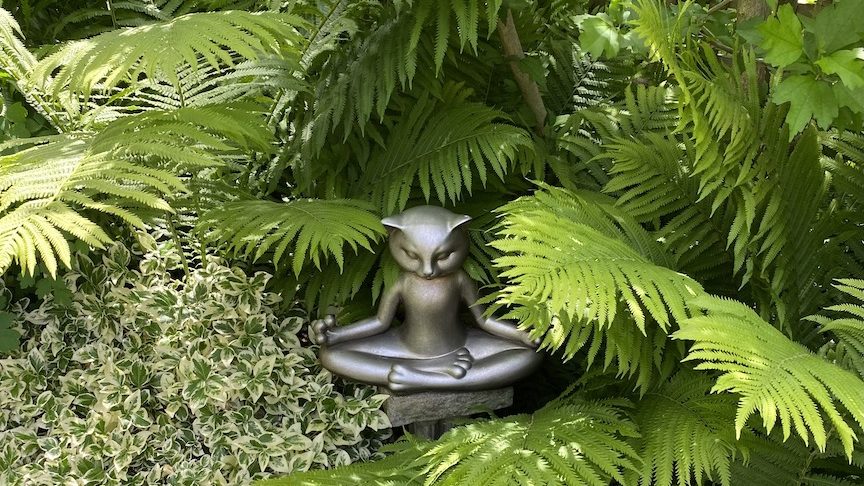
A meditative garden sculpture in a private garden in Toronto, Ontario.
What is “zen” anyways?
I assumed it had something to do with quietness and meditation–somehow getting into another plane of existence, etc., etc., etc. But after a little digging, I discovered that the actual word ‘zen’ comes from the Sanskrit root for ‘thought’ or ‘absorption’.
Absorption.
You hear a lot of talk about creating a garden space for meditating or simply chilling. This usually involves a garden (or part of a garden) that’s relatively minimalist. That’s fine. But the idea of creating a space that refines your focus so that you feel absorbed in the moment is something that really appeals to me.
I can’t help comparing the concept to something I learned from science writer Diane Ackerman–deep play. Deep play is a kind of absolute presence she describes as “a combination of clarity, wild enthusiasm, saturation in the moment, and wonder.”
So maybe a zen garden isn’t the place you’re likely to nurture wild enthusiasm but the rest seems like a good fit. Whatever you call it, the state of mind you want to encourage in your zen garden is the best inspiration for figuring out what your zen space will ultimately look like.

A mossy stone sculpture in the Japanese garden at Butchart Gardens, Vancouver Island, B.C.
Inspirations from tradition
How do you get from desired state of mind to actually enjoying said state of mind? Taking cues from hard core zen garden design is a good start. Traditional, centuries-old gardens in Japan tend to have some distinctive characteristics in common:
- Swaths of raked gravel
- Some well-placed, sculptural rocks
- Maybe a small foot bridge
- Maybe a stone lantern
What makes a traditional zen garden so distinctive, I think, is in what it doesn’t have:
- No flowering annuals or vibrantly blooming shrubs
- No artificial lighting system
- No wild mixes of plant textures and shapes
- No big water features
- No big views. Traditional zen gardens are usually enclosed by walls or fences to enhance the sense of looking inward and blocking out the rest of the world.
What I love most in these types of gardens is how large sculptural rocks are used. There’s a famous garden in Japan that features a collection of large rocks placed in a large gravel-covered area. What’s so very cool about this is that the rocks are placed so that as you walk along the paved pathway that encircles the gravelled area, there is always at least one rock that is not visible. So no matter where you stand along the perimeter of the garden, you can never see it’s entirety. That’s zen.
Bringing zen-ness to your crazy urban hideaway
There are plenty of how-tos for making a near-authentic zen garden and if that’s the direction you’d like to go then I say more power to you. But if you’d like to take a few inspirations from zen gardens to create a space that’s conducive to peaceful contemplation, here are some ideas.
MAKE IT A DEFINED SPACE
Taking a cue from traditional zen gardens, find or make a place in your garden that’s partially enclosed. You want a designated space that helps you focus inward rather than outward towards that shrub on the other side of the lawn that clearly needs to be pruned.
KEEP IT SIMPLE
Traditional zen gardens have minimalism down to an art. And there’s good reason for it. Loads of different plants, flowers, leaves, colours, etc., are delightful and also distracting. Go for a calming (and limited) collection of greenery.
DO YOUR TUSH A FAVOUR
Yes, stone benches fit very well into the whole Japanese zen vibe but they don’t exactly tempt you to linger and if you do you may find yourself zoning into your sore you-know-what. Do yourself a favour and invest in some seating that allows you to not think about the seating. The universe will reward you.
ADD SOME NOISE
If your garden is in an urban area, there’s going to be distracting background noise. If you can’t mask the noise, you can always add your own. Garden features that include falling or spouting water (although not strictly a traditional Japanese zen garden feature) are popular choices. There are ways of working with the breeze to battle noise, too, including hanging wind chimes and adding plants that make rustling sounds with their leaves like bamboo or aspens.
For the ultimate blanket noise fix, install an outdoor speaker system. Sure, you could drown out the sounds of cars and kids by blasting AC/DC but that might inspire a visit from the local constabulary. Instead, consider a playlist (played quietly) of birdsong, crickets chirping or a creek burbling. Think nature’s version of white noise. Believe it or not, there are playlists available featuring endless loops of these things.
ADD SOME DISTRACTIONS
I know it seems counter-intuitive (to put it kindly) that adding a distraction could actually make your garden more peaceful but hear me out. There is something to be said for the power of focus–you focusing so strongly on something that the noise and action around you seem diffused if not eliminated entirely. Maybe you’ve already experienced a moment like that at work when you did a deep dive into a project and got so involved that you no longer hear the buzz of colleagues and computers around you. Or maybe you’ve gotten lost in a painting at an art gallery while all the people milling around you have temporarily vanished. It happens.

A mini-zen garden, featuring a tray of sand and a tiny rake, makes a fun distraction along a path in Keppel Croft gardens, Big Bay, Ontario.
This is where the strategic placement of something can work a charm to help you focus and simultaneously tune out the churning world around you. Consider:
- A small sculpture
- A container potted up with a single, intriguing plant like a bonsai tree
- A large, intriguingly shaped stone
- A mini water feature (which can also help with masking outside noise, too)
Remember the basics
Traditional zen garden design is guided by seven principles:
- Austerity
- Simplicity
- Naturalness
- Asymmetry
- Mystery/subtlety (like that one rock always hidden from view)
- A break from the ordinary
- Stillness
Any one of these concepts is a terrific place to start your zen space. A combination of them could be the making of something sublime.
And couldn’t we all benefit from a little bit of the sublime right now?


 Ministry of the fence
I think you are in need of some zen-ness. Hope everything heals soon.
LikeLiked by 2 people
Thanks, Rick!
LikeLiked by 1 person