Where I live in Canada, spring can be about as long lived as an ice cream cone which is to say not long. Sometimes I feel like we barrel right through late winter into early summer with spring merely a squashed hope staining the sidewalk. It’s the fleetingness and fragility of ephemerals (plants that pop up, bloom and die back in a very short time frame) that make them the essence of springtime. What I didn’t realize until recently is that flowers aren’t the only glimpses of ephemeral magic.
Ephemeral flowers

Coltsfoot blooming in early May of last year near our cottage in Ontario.
We’re lucky that southwestern Ontario has a wealth of spring ephemerals that can be discovered in woodland areas and even along country roadsides. Coltsfoot, Trout Lilies, Hepatica and Trilliums all appear and then disappear in the window of warm sunshine-filled opportunity that happens between the over-story trees starting to bud and when their leaves are fully developed. It’s a small miracle to witness–splatterings of brilliant yellow or white for just days and then suddenly you turn around and there’s only a carpet of brown leaves.
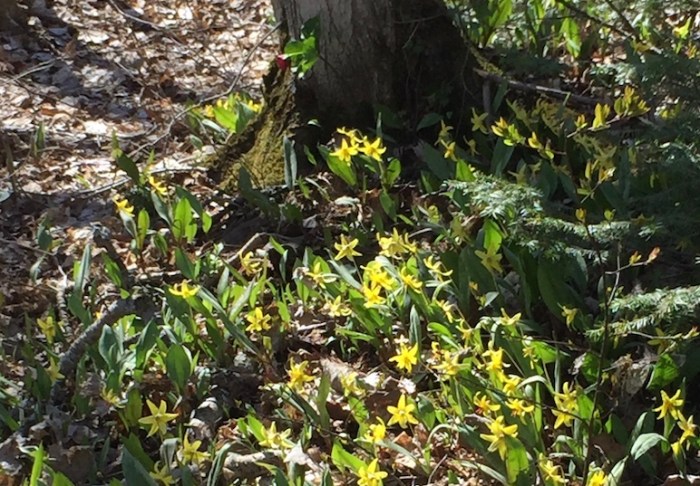
Tiny, daffodil-like Trout Lilies blooming in early May near our cottage in Ontario.
In the brief yet brilliant ephemeral plant world, there are more than just spring bloomers, however. There are Desert ephemerals–plants that only appear, bloom, reproduce and die back during a rain. There are Mud-flat ephemerals that only appear when the water in the area is particularly low. And there are weedy ephemerals like dandelion and chickweed that pop up between the gradings of a road’s soft shoulder.

Hepatica is one of our earliest ephemerals appearing at our cottage in Ontario.
Ephemeral ponds and streams
If you find a very large puddle or a small pond filling a low dip in the floor of a forest or woodland in early spring, that’s probably an ephemeral pond. These wonders are also referred to by the Shakespearean sounding ‘vernal pond’. If you’re unsure, revisit the spot a couple of times. If it has disappeared by the time summer has rolled around and doesn’t reappear until early the following spring, you’ve got a genuine vernal pond.
Vernal ponds are especially important for local eco-systems because, by their nature, vernal ponds aren’t home to fish so all kinds of other amphibians and invertebrates who would normally wind up as fish food, get to get on with it in relative peace. Here’s where you’re going to find salamanders and frogs making hay while the sunshines. Birds, snakes and turtles come to quench their thirst and snack on the aforementioned.
A stream can be ephemeral, too, if it’s only a stream for a brief time and the rest of the year it’s a dry path-where-water-used-to-flow.
Both ephemeral ponds and streams fall into a category called ephemeral ecosystems. Interestingly, researchers expect that the frequency and extent of these two wet/dry phenomena are likely to increase in the future in response to global climate change and increasing artificial water diversions from us humans.
Ephemeral art
Man-made ephemerality can be just as magical. Take the work of Andy Goldsworthy, an artist who creates miracles of colour and shape using natural materials. There’s glory and heartbreak in every piece because the works often only last until the next breeze or an incoming tide.
Ephemeral landscaping
Mr. Goldsworthy’s work takes the idea of ephemerality to extraordinary places. Could you apply the idea to your own garden, I wondered. I Googled “ephemeral landscaping” and wouldn’t you know there is such a thing. It’s all explained in a lovely post by Steve Cannon on his website Muddy Boots Landscaping. Give it a read. He explains the notion of a garden space that is naturally transformed just once a year. His example is a carpet of flower petals from a crabapple tree.
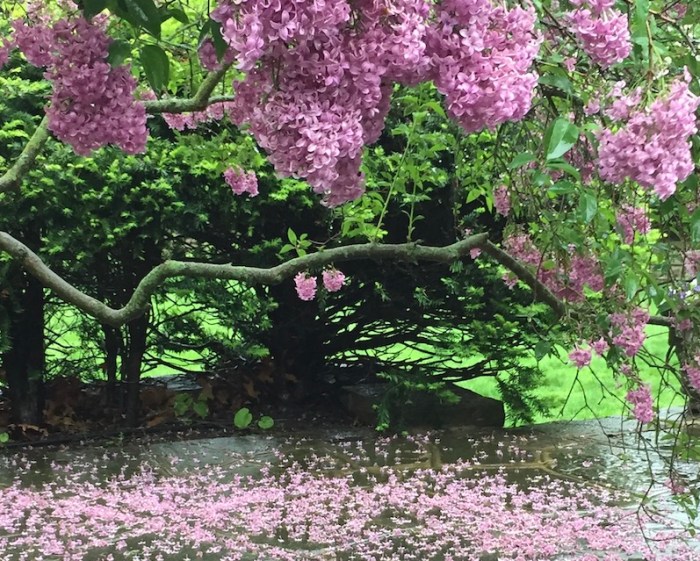
An old lilac bush sprinkles its petals onto a rain-soaked paved patio creating an ephemeral space.
This, of course, got me thinking. How cool would it be to intentionally include an ephemeral space in the garden? Maybe you already have some potential sites. Here are some ideas:
DO A LITTLE STONEHENGE-ING: Plant some dense shrubbery around a well-placed sculpture so that the setting or rising sun lights up the sculpture only for a few days each year.
USE THE SETTING SUN FOR THEATRICAL BACK LIGHTING: Plant some fall blooming flowers or ornamental grasses due west of your seating area so that cocktails at sunset can be enjoyed while soaking up the warmth and taking in the gorgeousness of the plants backlit by the autumn sun.
TURN YOUR SPRING GREEN LAWN PURPLE: Push a gazillion crocus or Blue Bell bulbs into the grass this coming autumn. Come spring, your lawn will green up and then burst into a carpet of purple (or blue or yellow or all of the above depending on your bulbs). Once everything has bloomed, wait a bit for the leaves to wither and brown. Meanwhile, let your grass grow a tad longer which is a good thing in the spring. Eventually, mow everything. The leaves of the bulbs will disappear, until next year.
Do you have a magic spot in your garden where an ephemeral beauty shimmers into your life for just a moment or a few days?


 Ministry of the fence