If you happen to be driving along a backroad on the Bruce Peninsula in early spring, you’d be forgiven for thinking that the dandelions have come early. Those bright yellow flowers sprinkled along a roadside ditch or covering a knoll beside a pasture in early March sure look like them.
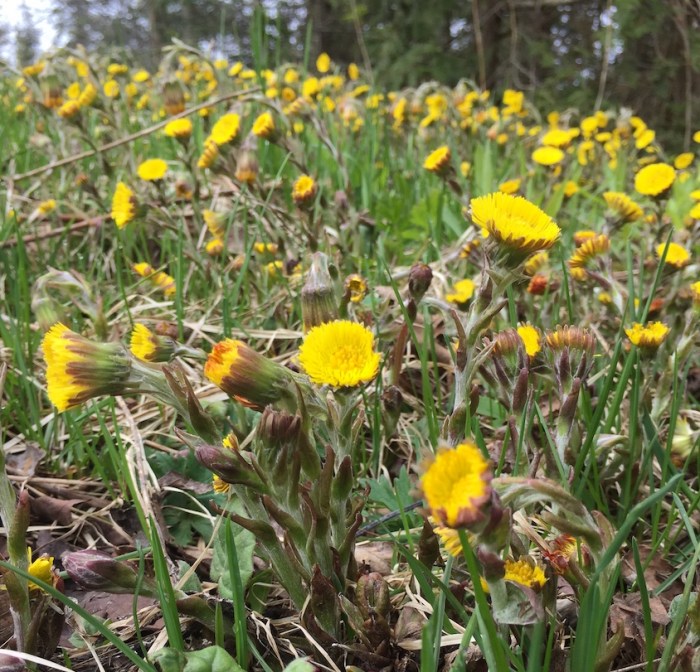
This hillside is covered with the largest patch of Coltsfoot I’ve ever found on the Bruce Peninsula in southwestern Ontario.
But were you to stop and go right up to these cheery little blooms, you’d notice how really different Tussilago farfara (aka Coltsfoot) is from the dandelion, a very distant cousin–both are in the Asteraceae family but Coltsfoot is a type of groundsel and dandelions are a type of chicory.
Sprung earliest in spring
A big difference between Coltsfoot and dandelions is that the former appear much earlier in spring than the latter. Coltsfoot show off their sunny yellow flowers long before dandelions because they just push up stems topped with blooms and worry about producing leaves much later. They can do this because they’ve stored up the necessary energy in their underground rhizomes from the year before. Meanwhile, dandelions plod along, producing their leaves first, soaking up the present year’s spring sunshine in order to push out some flowers.
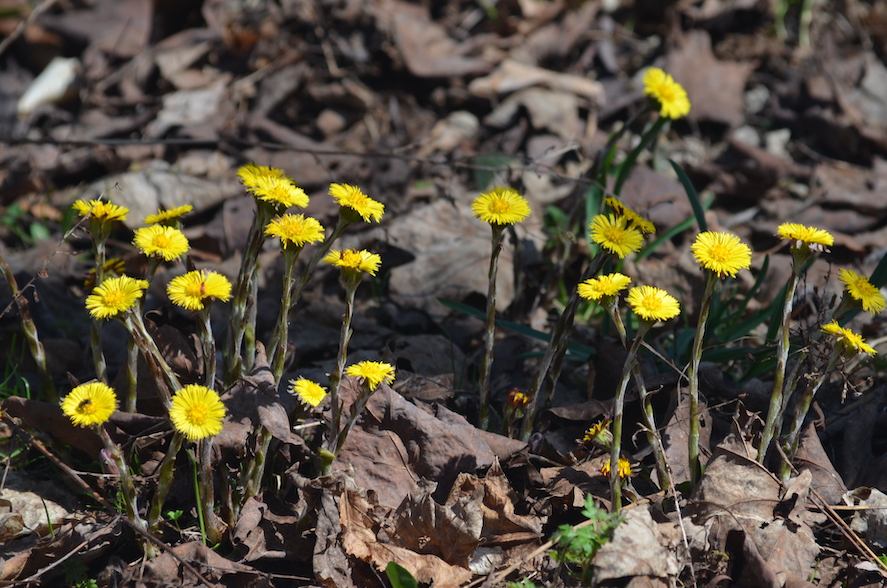
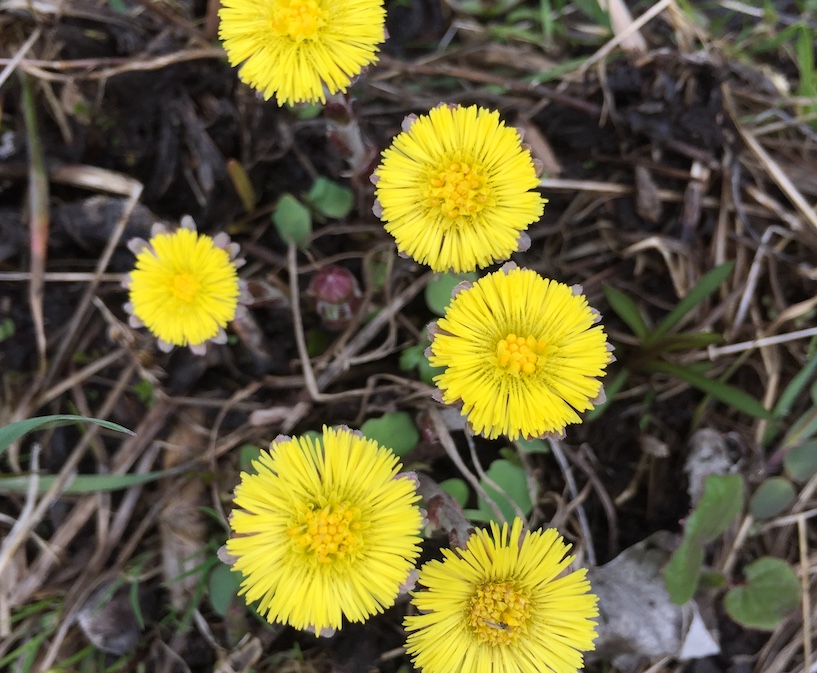
A closer look reveals the unique characteristics of Coltsfoot, including a daisy-like flower and purple, scaled stems.
Coltsfoot stems are a lovely combination of soft grey (a woolly fuzz) and deep purple (the emerging leaves), unlike the plain, smooth green stems of dandelions. And Coltsfoot flowers are quite different as well, showing a distinct daisy-like centre. If you can catch Coltsfoot just before it’s seeded and vanished, you’ll see another big difference between it and dandelions. Coltsfoot leaves are heart-shaped (kind of like a horse’s hoof, hence its name).
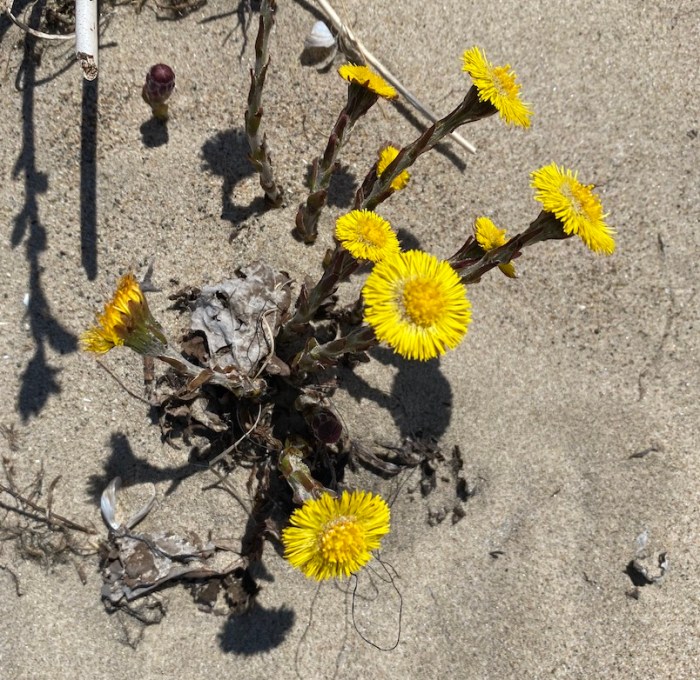
Coltsfoot will thrive in places a lot of plants would find undesirable like sandy hillsides (see above), gravel pits, ditches and disturbed areas.
Small flower, big rep
Finding Coltsfoot isn’t all that easy. Dandelions might carpet a landscape but Coltsfoot seem happy to pop up in small patches. This is a conundrum for me as a lot of agricultural and environmental agencies declare Coltsfoot (a non-native to North America) as a pest and invasive. I suppose it depends on where you stand (quite literally). You can still find it in the wild in southern Ontario, southern Quebec and Canada’s eastern provinces and most of northeastern United States.
They’re native to Western Europe, northern Asia and North Africa. Botanists believe they arrived in North America with colonists who relied on the plant for its purported medicinal qualities. The leaves and roots were used in the treatment of a wide range of ailments including coughs, diarrhea, skin diseases, ulcers, blemishes and burns. It’s been a popular remedy for a long time. One of the first written documents in English mentioning the wonders of Coltsfoot as a cure-all was published in 1597. This is unfortunate because (modern) research has linked components of the plant to liver damage, blood clots and cancer.
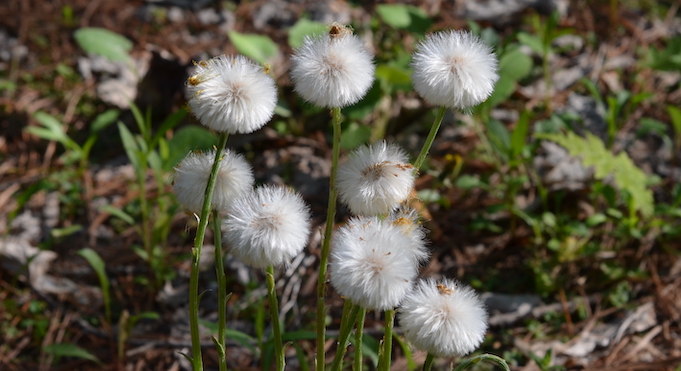
Coltsfoot seed-heads, photographed in mid-June.
I think one of the wonderful things about Coltsfoot is how their appearance can light up the last of winter’s grey days with its zingy blooms. But their brilliance is brief. As early as they are arrive in spring, they’re just as early to leave. Coltsfoot seed often matures just around the time that dandelions are about to bloom.
In your garden
Coltsfoot seed sold commercially isn’t easy to find and maybe that’s a good thing. Some wildflowers (non-native or otherwise) like the Trout Lily and the Trillium are extra special just because they’re not around for very long.


Pingback: Ephemeral magic: Petals, ponds, patios and more | Ministry of the fence