Spring is in the air and each day more birds are showing up, singing their hearts out and partying on. But there’s a problem. By all reports, everyone’s doing fine in the making babies, erm, eggs department but hatching and caring for the demanding little rascals has become more of a challenge due to an urban wildlife housing crisis. Essentially, suitable accommodations are getting harder to find because us humans, worried about keeping everything neat and tidy, have contributed to a significant lack of dead and decaying trees.

The Canadian Wildlife Federation reports that about a quarter of all Canadian bird species nest in conveniently hole-y decaying trees. And it’s not just the birds that are having trouble. Eighty-nine species of birds, mammals and insects depend on deadwood for nesting, roosting, breeding and food storage. So what’s a bird (or a human for that matter) to do?
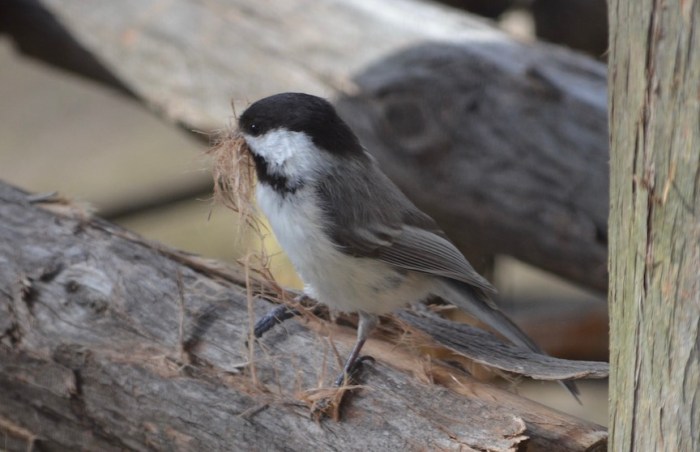
A Black-capped Chickadee pulls up wood fibres for nesting from our vintage log table on our cottage deck in Ontario.
Act now!
The bad news is that the best time to put out a bird house or nesting box is in the fall or winter according to the Environmental Literacy Council. That gives potential occupants the maximum amount of time to A) discover the new digs and B) get familiar with the shelter and the area. Birds will actually use various shelters throughout the year so your early efforts may be greatly appreciated. (Get all the terrific insights on why fall/winter is best here.)
The good news is that any time you try to help birds in particular and wildlife in general is a good time. So don’t wait. Start building or shopping now. Go ahead. I’ll wait.
Wait a minute…

A baby Blue Jay, perched in a tree near the deck of our cottage in Ontario, flutters its wings and calls to signal (roughly translated) “Feed me. Feed me. NOW!”
Size matters, as does colour, positioning, etc.
The size of the entrance hole to your bird house or nesting box determines how welcoming the shelter will be to various birds. If you want to do the most good, do the research to find out the size most popular with the birds you see the most frequently in your garden. Cornell Lab has a great chart on various entrance sizes for attracting everything from a House Wren (1 1/8″) to a Screech Owl (3″).
Other important points of exterior and interior bird home design include:
- Choose drab colours. I know it’s hard to walk away from the cheerily painted bird house but your chances of getting a bird family moving in will increase if the abode is painted in colours that essentially approximate camouflage.
- Point the front of the house to face northeast to avoid drafts and up the coziness factor.
- Place the house in the shade, not in direct sunlight. Otherwise, you’ll have baked birds.
- Resist the urge to add a perch. Perches can actually be a hazard because they make it easier for predators to access the inside.

A father Grosbeak uses the roof of our old bird feeder to feed his hungry chick.
Housing for other critters, too
If you’re on a roll, consider buying or constructing nest boxes for other critters as well. A quick Google search can offer up all kinds of instructions for the ultimate boltholes for wild ducks, flying squirrels, and, of course, bats.
Early spring is also the time for upping your frog hospitality and if you’re interested in learning more about providing homes for solitary bees, try Help for the Hive-nots.
Everyone’s welcome

A Turkey Vulture surveys the traffic on our small lake from the peak of our vintage boat house.
Our native Turkey Vultures will soon be making an appearance as well. No, they’re not cute. They don’t even have a pretty song to sing. But they are an unmistakable harbinger of spring in Ontario. Ontario Parks goes so far as to call Turkey Vultures “the ultimate spring bird” not only because they’re springtime entrance on the scene is always head-turning–they have a 6 foot wingspan, after all. The enthusiasts at Ontario Parks declare these, um, striking birds essential players in the drama of spring because “[t]hey are the crime scene cleanup crew of the animal world.” Needless to say, I’m going to assume these guys have their nest-building situation well under control.


 Ministry of the fence
“harry eye”…lol
LikeLiked by 1 person
Pingback: A fluff piece for the birds | Rhymes with Linnaeus
Nice, informative post. Thank you for the link. 🙂
LikeLike
Thanks for the encouraging feedback. Much appreciated.
LikeLike