I was having a lovely (long distance) conversation with my dear friend (and outstanding gardener) who lives in Gananoque, Ontario about, oh, loads of things when the subject of fedges came up. I know. It is an unlikely topic of conversation. But I had seen fedges mentioned in a magazine and, of course, the meaning of the word had completely escaped my mind and we were both trying to figure out the term. Later, I did a little digging (figuratively not literally) and it turns out that fedge is usually considered a mash-up of the words fence and hedge. It’s an old concept, actually, commonly involving willow cuttings. The stems (which are quite flexible and root easily) are planted closely in a row and woven together in a pleasing pattern that produces, eventually, a lovely living fence (which also happens to be free if you have a large willow nearby to get your cuttings).
Here’s where I get confused. If a hedge of shrubbery is planted along a property line or is used in any way to demarcate an area, well, isn’t that already a living fence? Why the new word? I mean, this isn’t keeping me up at night but…
Fir hedge

What if you already have a living fence made out of firs like the one shown above? Is a fir hedge a fedge too?
Don’t get me wrong. I think ‘fedge’ as a general gardening idea has legs.
Just think of the possibilities.
Fancy hedge
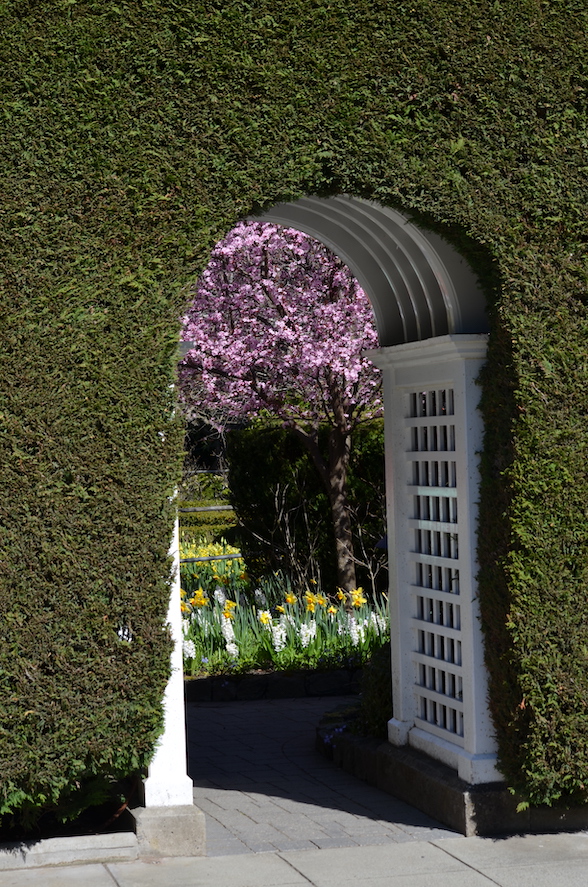
A trellised archway pierces a huge, very dense hedge at Butchart Gardens on Vancouver Island.
What if you had a really fancy hedge, like the one above? This hedge separates two garden spaces in Butchart Gardens on Vancouver Island. It’s actually not only fancy but formidable (very tall, very wide and very dense). Does that make it a ffedge?
And then there are all the other weird and wonderful hedge manifestations like…
Double hedge


Twin hedges lining a narrow stone pathway encircle a lawn in North Toronto.
Ok, I’m calling it. The photos above feature a dedge. The double hedges are planted so close together that the stone path that separates them is barely walkable but that’s not the point. Two different types of evergreen shrubs, one for each hedge, make for the subtlest of differences in texture and colour–just enough of a difference to emphasize their elegant, parallel sweep.
And then there’s another kind of fedge
There’s yet another explanation for the term fedge–a mash-up of food and hedge. Basically, this means planting shrubs that bear edible fruit to produce a living fence that also feeds you. Needless to say, you need a lot of room for an edible fedge because you can’t really keep it neatly trimmed without risk of losing a fair amount of your potential harvest.
If you’re interested in foodscaping, edible fedges are a great place to start.
- Try a rosemary fedge where you would normally line a garden bed with a low boxwood hedge.
- If you don’t mind an extra wide fedge, you could plant a row of raspberry canes or blueberry bushes.
- For a fedge that delivers gorgeous blooms in spring as well as wonderful fruit, my fave is quince.
- If you want a native (for Canada) option, consider Elderberry (Sambucus canadensis) or Highbush Cranberry (Viburnum trilobum).
- Plant a long row of dwarf fruit trees.
The world of fedges is wide and fascinating. But, then again, just about anything tall(-ish) and relatively sturdy or dense, when planted in a row could work as a living fence in my opinion.
It’s all in how you look at it.


 Ministry of the fence
Has fedge been approved for use by the Oxford English Dictionary?
LikeLiked by 1 person
😄
LikeLike