Less than a week has gone by and I’m raring to stuff all the Christmas decor back into their various boxes, bins and tins and shlump the lot to the basement for storage. But, instead, we’ll keep everything up and twinkling for at least another few days. All the (step) kids and their kids are coming over for a New Year’s dinner and the festive bits and pieces, tree included, are expected. We’ll salute the old year, don funny paper hats, eat too many sweets and take one last long look at our crazy collection of tree decorations.
Once the festivities are well and truly over, I always feel a twinge of guilt as my guy hoists the tree, stripped of lights and baubles, down the stairs and out the door. Our Christmas trees do such a grand job of looking quintessentially Christmas-y and, in the end, their end is pretty undignified.
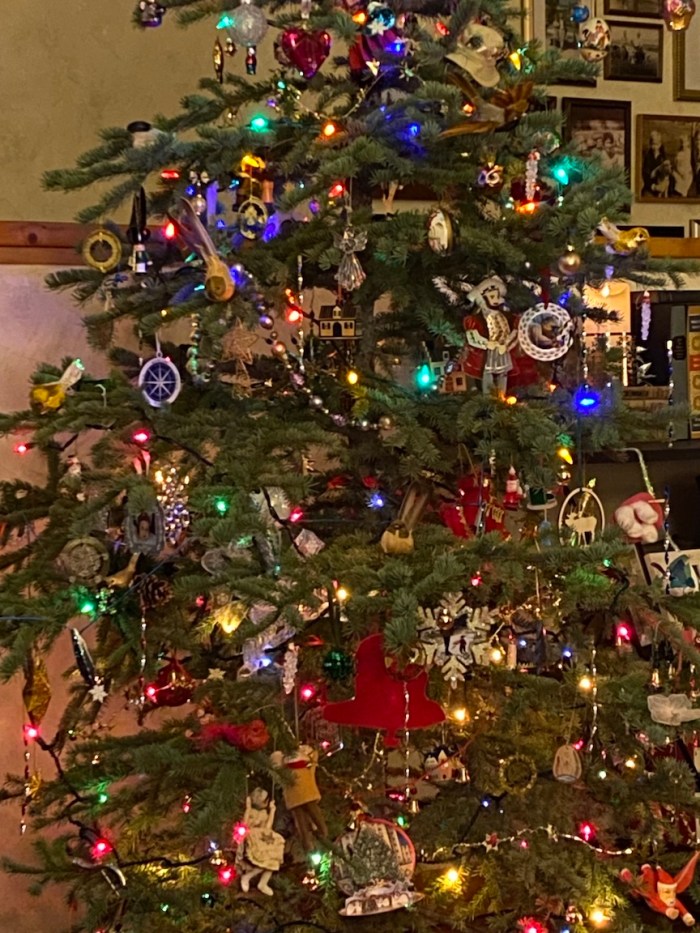
Our Christmas tree is covered with decorations new, old, gifted or crafted over many years.
Here in Fernie, we’ve got the option of hauling our (real) trees over to a specially designated spot near the community pool parking lot. The trees are heaped into a huge pile and then, on an evening designated by the town and the local fire department, the trees are set ablaze in one ferociously large bonfire. Kids race around amongst the flying sparks and embers, remarkably not catching fire themselves, while neighbours share spiked hot drinks. Ahhhhh, you gotta love small town life.
There are loads of information to be had on how to recycle your used organic trees in ways that can be beneficial to the environment. (Building and igniting a bonfire isn’t one of them.) But figuring out ways to make Christmas tree production–growing the saplings–also environmentally beneficial hasn’t been much of a thing (as far as I can tell). Until now.

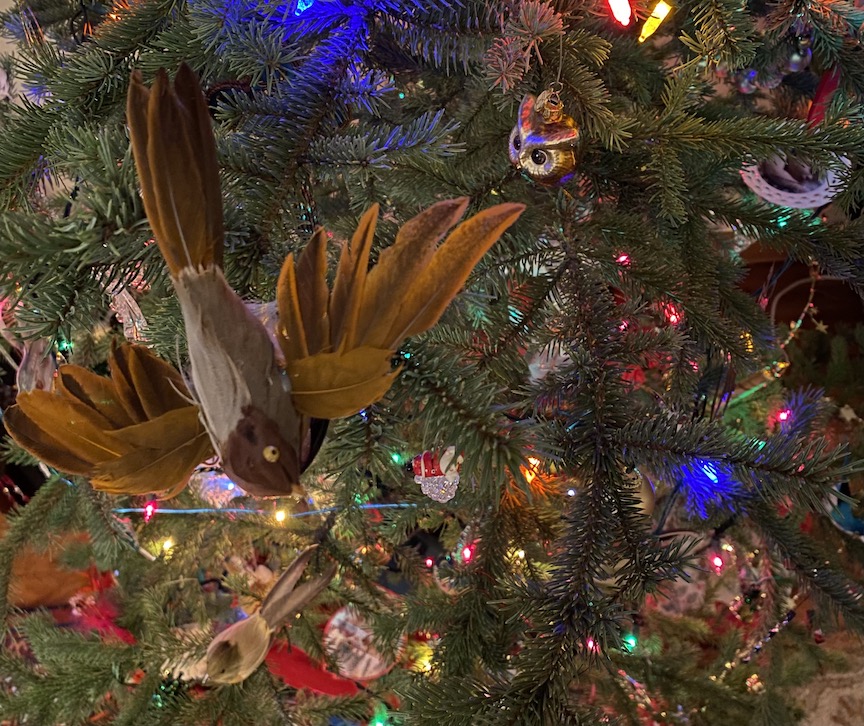

Every person’s Christmas tree must be a unique blend of tradition, family history and taste.
On an island in Scotland, a new practice called mycoforestry involves growing trees and food on the same plot of land at the same time. That means not having to resort to deforestation in order to plant a food crop and it also means the land used for growing Christmas trees has more than one purpose. The food crop is mushrooms which just happen to thrive around tree roots. Not surprisingly, one of the people who spearheaded the project has a background in truffle harvesting. Check out Wired’s How Christmas Trees Could Become A Source of Low-Carbon Protein for the whole remarkable story.
I don’t know about you but I’m heading into this new year feeling uncharacteristically uneasy. Usually the New Year celebrations has me feeling optimistic, excited even, for what’s ahead. But, with no real inkling about what our immediate future has in store for us, stories about pioneering work in botany and horticulture are welcome news–whatever can make the world a little better, a little healthier, a little more productive without being harmful.
Let’s grab each others’ hands (metaphorically) and take a leap of faith together into 2025. Whatever happens this coming year, we’ll at least know for sure that it’s going to be a great year for gardening.


 Ministry of the fence
Happy New Year, and I hope you have a lovely family celebration. We have no visitors coming, so the decorations have been put away, and we’re back to our regularly scheduled routine. Bring on gardening season. 🙂
LikeLiked by 2 people
Happy New Year to you and yours as well. And three cheers to bringing on the gardening!
LikeLiked by 1 person