About a week ago, King Charles III, while in Bordeaux, France, got his hands dirty (symbolically, at least) by planting a Loquat Leaf Oak. This, in itself, is not news. Royalty and other VIPs the world over often make gestures like planting trees for the sake of bonhomie and a great photo op. But this tree is a special one. Quercus rysophylla may be the next new big thing in Canada, for better or worse.
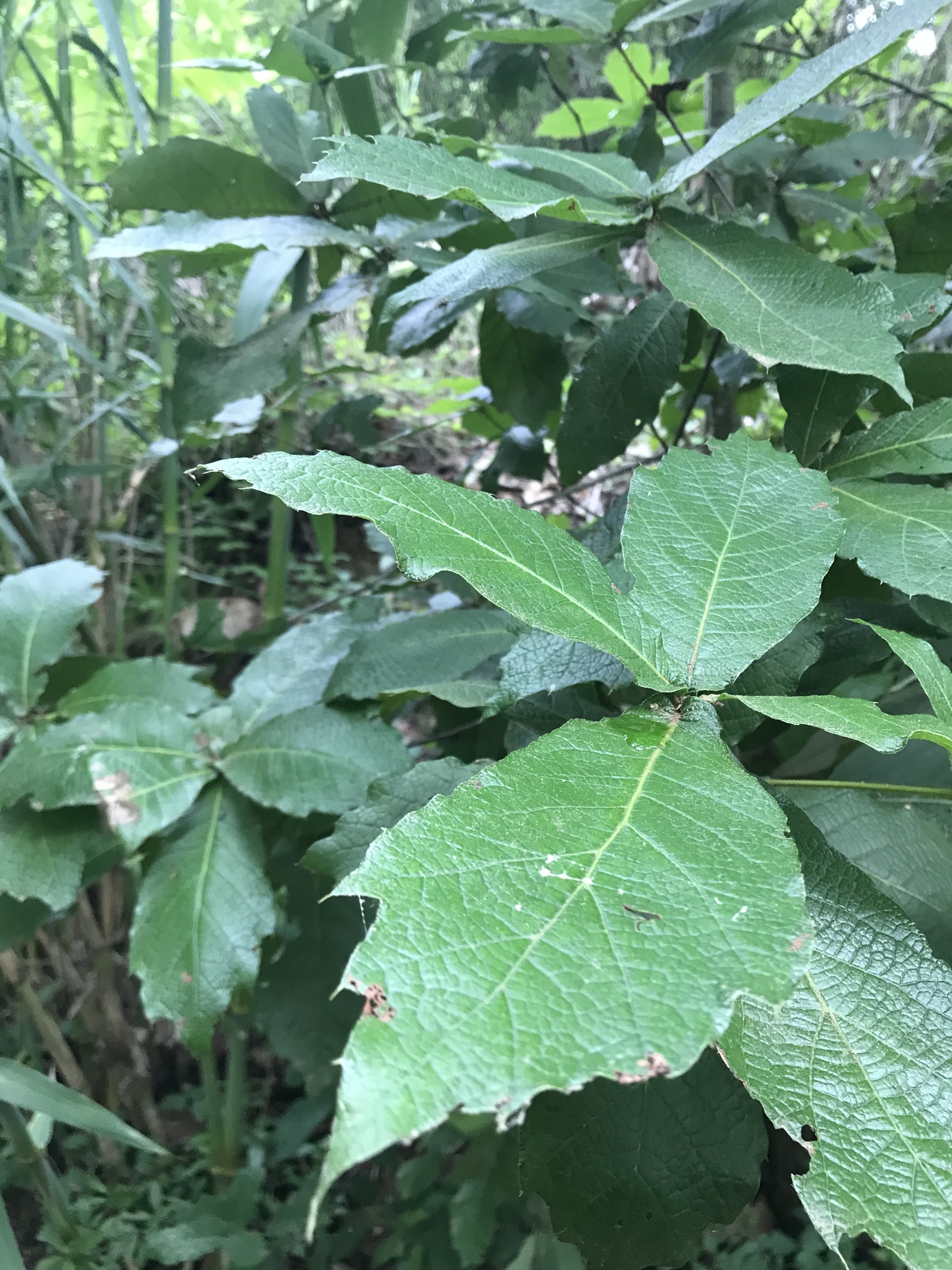
Photo: Adriana Nelly Correa Sandoval, CC BY 4.0 https://creativecommons.org/licenses/by/4.0, via Wikimedia Commons
But, first, there’s a potential mix-up to clear up. The Loquat Leaf is not the same as a Loquat, Eriobotrya japonica. The Loquat is an evergreen shrub grown commercially by nurseries as an ornamental plant for gardens as well as by farms in China, Spain, Pakistan and Turkey for its sweet, orange-coloured fruit and for its leaves which are used to make herbal tea. It’s been known in China for at least a thousand years. The ancient Chinese poet, Su Shi, who lived from 1037 to 1101, famously gave the plant the name Loquat by mistake. But that’s another story.
When a leaf is all you have
The Loquat Leaf hails from Mexico, originally. It’s a species of Live Oak because its leaves are evergreen and, also being part of the red oak group, produces acorns biennially. In the wild, so to speak, you’d find it growing in humid canyons, north-facing slopes, in cloud forests, on limestone and at elevations from 1,600 to 5,600 feet.
Even though the Loquat Leaf is not anywhere near in relation to the Loquat, they have similarly shaped leaves. Hence, when the Loquat Leaf came to the attention of international horticulturalists after its “discovery” in 1910, it gained its somewhat confusing common name.
The rare evergreen oak that’s on the move
If you’re Canadian, you’ll be forgiven for never having heard of this tree, unless you’re an avid reader of King Charles III news. That’s probably because you can’t get the tree in Canada. In fact, it’s quite possible only one exists here. Last February, its rarity made it a headliner in the New Westminster Record, the local paper for the city located southeast of Vancouver. Evidently, the tree was bought at a nursery in Portland, Oregon, and planted by city staff in a traffic circle. It had to be moved because of underground works on utility infrastructure. Interestingly, the city’s senior arborist, quoted in the article, said the reason that tree was chosen in the first place was because of “a hunch that it might be adaptive to the anticipated change in climate.”
Almost everywhere but here
Loquat Leaf can now be seen, though not purchased and grown by any old gardener, it seems, in countries as far flung as New Zealand, Italy, Luxembourg and some parts of the U.S. including Texas, California, Oregon and the Carolinas. But these are all basically species trees, often carefully nurtured from seed or a cutting by dedicated horticulturalists. England has had great success with the tree. You can find some at the venerable RBG Kew. And, in Ireland, you can actually buy one from Caragh Nurseries for a cool 2,500 euros. That’s over $3,500 Cdn in case you were interested.
Elusive, but for long?
The New Westminster Record article goes on to mention that the city staff dealing with the tree “are also collaborating with the UBC Botanical Garden and local nurseries to collect plant tissue for reproduction“. I wouldn’t hold my breath on that. But I suspect we’ll hear more about the Loquat Leaf in coming years. Evidently, it’s “a species known for its resilience in the face of a changing climate.” It’s why King Charles III, renowned as a passionate environmentalist, made a big point of planting a Loquat Leaf, his actions bound to produce a photo that virtually every media outlet in the world would snap up. It’s also why that New Westminster arborist planted Canada’s only existing Loquat Leaf ten years ago and then made the effort to safely relocate it last spring.
I wish that somehow we could continue to seek out unusual trees from exotic locales for our gardens simply for their quirky beauty. And I wish we didn’t need to prepare for the likelihood that we may lose some of our native trees to the changing climate. But as our climate crisis worsens, climate adaptability will be a much desired attribute for garden plants. For better or worse, we Canadians will probably be hearing more and seeing more of the Loquat Leaf in the future. I hope it’s the distant future.


 Ministry of the fence
Pingback: Zone shifts reflect climate change | Ministry of the fence
Isn’t he King Charles #3?
Sent from Alison’s iPhone
<
div dir=”ltr”>
<
blockquote type=”cite”>
LikeLiked by 1 person
Oops! Alison, you are so right! Thanks for spotting that and pointing it out to me. I’ve corrected the post. Cheers!
LikeLike