I love a good gardening tip that saves time and effort and–big bonus–helps the environment. One of my favourites is to use gone-past-sell-by fruits and dinner leftovers cleanly and efficiently in your garden without having to compost.
Sure, there are good reasons to start composting, top of the list being you reduce food waste and create your own, healthy, organic fertilizer. But don’t you want, sometimes, to sidestep the whole long drawn out composting process and just get straight to the planting and fertilizing stage?
Here are 4 of my favourite straight-into-the-garden foods that I find work wonders.
1. Whole bananas
I don’t know where I first read about a gardener whose secret to beds of lush roses was to give each plant a whole banana. I vaguely remember the gardener being a part of the team that planted the thousands of roses in New York City’s Central Park but I can’t find any written proof to back up that notion. No matter. I’ve been using potassium-rich bananas as fertilizer for the longest time with great results. Next time you have some over-ripe bananas, resist the urge to make banana muffins and start chopping.
Lots of gardening guides advise that you use the peel exclusively. I don’t. I use the whole unpeeled banana. I just chop it up, peel and all, and sprinkle the pieces into the bottom of my plant hole before adding the plant. I never plant a rose without giving it a great head start with a whole banana.
Caveat: I only use a whole banana as fertilizer for large plants requiring deep planting holes. This is because if you put chunks of whole banana in a shallow hole or simply scatter them on the ground, you’re bound to attract all kinds of banana-loving critters such as racoons or rats.
You can make banana peel tea if you want to spread all that banana goodness to smaller plants and plants in pots or raised beds. The Farmer’s Almanac has a good recipe. Keep in mind though, that the resulting tea is strong. You’ll need to dilute it quite a bit. Follow the link above to know how much. If you don’t, you can run the risk of the sweet smelling brew attracting nasty bugs.
Bananas are great for: Roses and any large, shrubby flowering perennial as well as tomatoes and peppers.
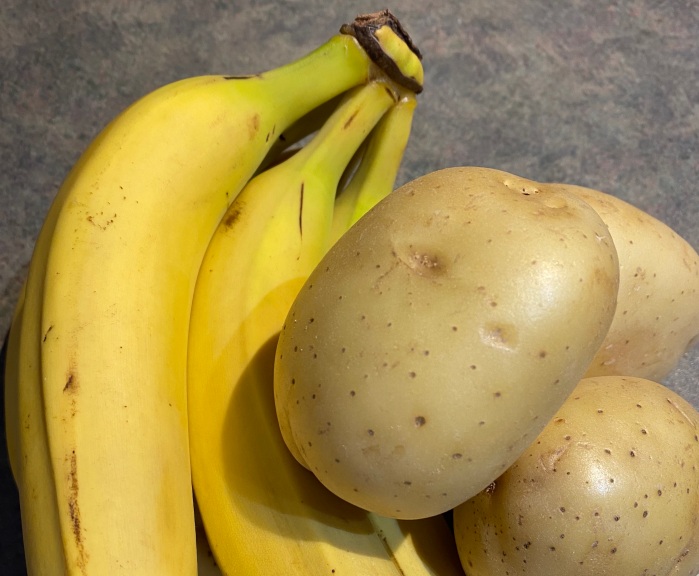
Whole bananas and potato peels are the raw materials for great, easy plant fertilizer.
2. Eggshells
Eggshells are wonderful packages of calcium carbonate. They can also go straight into the ground like bananas but I like to crumble them up a bit first. The only problem with shells, crushed or left whole, is that they take a long time to break down in soil so when you want to send all that calcium goodness to your plant in the fastest and most efficient way, try eggshell tea. It’s easy to make and doesn’t take a long time.
Wash your eggshells thoroughly. Once they’re thoroughly dry, crush them as finely as you can and put them in a heat-proof bowl with a lid and pour boiling water over them. Cover and let the shells steep for up to a week.
A faster hack: If you’re making hard-boiled eggs, save the water. Let it cool. Water your plants with abandon (taking note of the warning below).
Eggshells are great for: tomatoes, broccoli, pepper, eggplants, cauliflower, strawberries but do not apply to cabbage, beans and spinach. Eggshells and eggshell tea are also great for roses and chrysanthemums.
3. Orange peel
Whether you’ve got an over-ripe orange or not, either way you’re probably not going to eat the rind. But orange peel is surprisingly beneficial to acid-soil-loving plants. To make it easily consumable to them, though, you’ll have to put in a little effort, although it won’t take nearly as much time as waiting for the peels to break down in your composting bin.
Dry your peels, either in the sun or a fruit dryer or low and slow in the oven. Once they are completely dehydrated, grind the peel into a powder using a spice/coffee grinder or simply chop the peel pieces as finely as you can. Sprinkle on soil and mix to add nutrients and to adjust the soil to be more acidic.
Orange peel is great for: hydrangeas, rhododendrons, camellias
4. Potato peel
Nutrient-rich potato peels can also be steeped in water to make a plant-friendly tea. Just take a handful of peels, drop it in a container of water and let them steep about four days or up to a week. Give the brew a quick stir every day during this steeping period. Strain the mixture and start watering your plants.
An even faster method is to keep the water you just boiled the potatoes you’re making for dinner. Wait for the water to cool and store the water in the fridge until ready to use. Be sure to stir up the water before pouring.
Caveat: If you like to salt the water you’re using to boil your potatoes, don’t use it afterwards for your plants.
Potato peel tea is great for: Vegetables, herbs, flowering plants and indoor plants, even cacti.
How far can I take this ‘tea’ thing?
The water you’ve used to boil virtually any vegetable can be recycled as homemade fertilizer. I’ve heard that even pasta water is beneficial to plants although I can’t claim I’ve tried that on my plants.
So get into the habit of saving your cooking water. You’ll be giving both your garden and the environment a big flavour. (Sorry.)
If you have any specialty tea recipes you use for your garden, I’d love to hear about them. Please share!


Pingback: 💧 How Often to Water & Feed Tea Plants: The 2026 Guide - Growing Teas
Pingback: ORS for Dehydration: Benefits, Dosage, Uses & Side Effects
Pingback: How to Make Banana Peel Water for Plants: A Gardener's Guide That Actually Works - Green Nest
thanx for your tips.. I’m new at gardening, so I saw so many homemade fertilizer tricks and made banana,potato and orange peel water for my plants to test things out. Now, my biggest question..when should I use it and how regularly? Also, if I use one on my plants, can I also use another and can I combine these 3 to use?
LikeLiked by 1 person
Hi, Angie! This is a great question. But first, congrats on making homemade fertilizer! I’m going to break up your question into parts because you’ve touched on a topic that covers a lot of territory.
WHEN TO FERTILIZE: Generally speaking, it’s best to fertilize plants in early spring through summer. But there are some caveats. The soil around the root area should be moist which makes it easier for the roots to take up the nutrients from the fertilizer. So don’t fertilize your plants if they’ve suffered from drought (ie you forgot to water them). Use plain water to revive them and once they’re back up to their normal perky selves, then fertilize. The same goes if you’ve overwatered a plant. Fertilizer added to wet/muddy soil will only run off and you’ll be wasting it. And start holding off on the fertilizer at the end of your plant’s growing season. You don’t want to feed a plant when it is naturally entering its dormancy stage. If you do, you could encourage new growth when that really shouldn’t be happening. So basically, fertilize when you’re transplanting a plant (like tossing that banana into the hole you’ve dug for that new rose) and throughout the season(s) when you see your plant producing new growth like leaves or flowers. One more tip – try to fertilize during the coolest part of the day (early morning or in the evening), especially during the hottest days of summer.
HOW MUCH FERTILIZER: Even when you’re using organic, homemade fertilizer, it’s possible to over-fertilize (too often and/or too much) which can burn the roots. Any fertilizer made with water and food scraps (like potato skins) is not a slow-release fertilizer. Those nutrients are going straight to the roots. It’s always best to go easy. A good dose of your homemade fertilizer in the spring or when you transplant your plant and, after that, only applied once or twice a month in best. Either that or dilute your fertilizer by adding just a little to your watering can if you feel the need to fertilize more. You’ll know if you’re over fertilizing. Plants will register their complaint by growing leggy, yellowing leaves, etc.
COMBINING FERTILIZERS: As much as your plants may think all of your homemade fertilizers are yummy delicious, you have to consider that bananas, potatoes and orange peel each deliver a different blend of nutrition and plants can often benefit from a particular type of nutrition to grow their best. (Also keep in mind you can over-fertilize. See above.) For instance, potato skin fertilizer delivers a great concoction of potassium, magnesium and phosphorus and the starch degrades in the soil by microbes to add nitrogen. So it’s a good, all-round fertilizer. Chopped banana peel is great as a one-and-done fertilizer but you need to add the peel to the bottom of a deep hole to prevent animals from digging up the peel and also to not attract fruit flies or worse. So peels are not great for houseplants, for instance. Orange peel is acidic so you’ll want to use it for fertilizing acid-loving plants such as hydrangeas and camellias.
And just to make things a wee more complicated, keep in mind that some plants actually prefer not to be fertilized. Many herbs, for instance, thrive in poor soil.
My best tip for you is that when you buy a plant, ask the pro at the garden centre which soil supplement (nitrogen? potassium? acid?) is best for that particular plant and then match up that nutrient with one of your homemade fertilizers. Then, of course, there’s always Google.
Good luck with your fertilizing and happy gardening! Let me know how it goes.
LikeLike
Pingback: "Banana Boost: Fertilizing with Whole Bananas for Thriving Plants" - Botanical Garden website
I read that a tea with weeds is really good too. Just don’t use weeds with seeds or pesticides
LikeLiked by 1 person
Pingback: Garden predictions: Hammocks, out, Rain-saving, in. | Ministry of the fence
Pingback: Not-so-obvious fruit tree planting tips | Ministry of the fence
Pingback: Rose success from bed to table | Ministry of the fence
what can I add to base of new Plum /Pear trees
I’m planting in a few days
many thanks
LikeLiked by 1 person
Hi, Margo! Thanks for reaching out.
You’re smart to be planting your fruit trees early in the growing season. Keep in mind that any type of soil amendment or fertilizer won’t help if the soil and drainage aren’t right for your trees. Luckily, plums are very undemanding. They’ll thrive in just about any soil except sandy, dry soil. Pears are not happy in lime-rich or dry soils but can tolerate heavier, poor-draining soil. You can’t go wrong with deep holes filled with well-draining loam for either tree.
All fruit trees are heavy feeders and love a conventional smorgasbord of nitrogen, macro and micronutrients. There are plenty of commercially sold fertilizers specifically formulated for fruit trees that contain all those things. The trick is to only apply a fertilizer (organic or chemical) to make up for what your soil is lacking and what your trees need. Apply too much nitrogen, for instance, and you’ll get more leaves than fruit. In the case of your pear tree, too much nitrogen can stimulate new shoots that are susceptible to fire blight.
Oregon State University’s Extension Service has a good report on Fertilizing Fruit Trees (https://extension.oregonstate.edu/gardening/berries-fruit/fertilizing-fruit-trees#:~:text=It%20is%20a%20good%20practice,line%20of%20the%20young%20tree.) and, interestingly, it states that it’s best to hold off using any nitrogen fertilizer for several months in the first growing season until your young trees’ root systems are established. Then, apply 5-10 pounds of aged manure, sprinkled around the tree’s drip line and carefully dig it in. Also keep in mind that adding nitrogen fertilizer to the hole before planting the tree you can risk burning the roots.
Is there a magic/organic ingredient like bananas to help your fruit trees off to their best start? Bananas can deliver lots of goodness to your young fruit trees, including calcium, magnesium, sulphur, phosphorus and potassium. Rather than throwing chunks of unpeeled fruit into the bottom of each hole, however, make the goodness easier for your trees to absorb by turning some bananas into a type of homemade slow-release fertilizer. Essentially, use a dehydrator or your oven to dry pieces of banana and they grind the pieces into powder and mix into your soil.
The best on-going organic nitrogen supplier for your trees, in my opinion, is clover – a natural nitrogen-fixing cover crop also known as green manure. The clover’s root system offers great soil conditioning and, once mowed down and dug into the soil, offers extra nitrogen for your trees. If you’re hard pressed to decide between red and white clover, red clover attracts more beneficial insects than white clover. But both clovers also make excellent weed suppressors. One word of caution, clover can be quite invasive so be prepared to have it pop up uninvited in your lawn and garden beds (which isn’t necessarily a bad thing).
Good luck with your plantings! I hope to hear all about your terrific fruit harvests some day!
LikeLike