Is your front yard a monotonous carpet of monotone green? Maybe this is the year you ditch traditional grass for something a little more interesting–a tapestry lawn. If you’re thinking this idea sounds vaguely familiar, you’re not wrong. Creating lawn alternatives with a greater diversity of plants is not new. After all, it’s a great way to get a ground cover that delivers way more colour and texture than a monoculture turf and it can also be a more environmentally friendly option. What’s fun about this latest iteration of lawn subs are the extraordinary colour and texture combos. Here are three ways to upholster a garden space with eye-catching coverage.
1. Grow bold with a vibrant tapestry
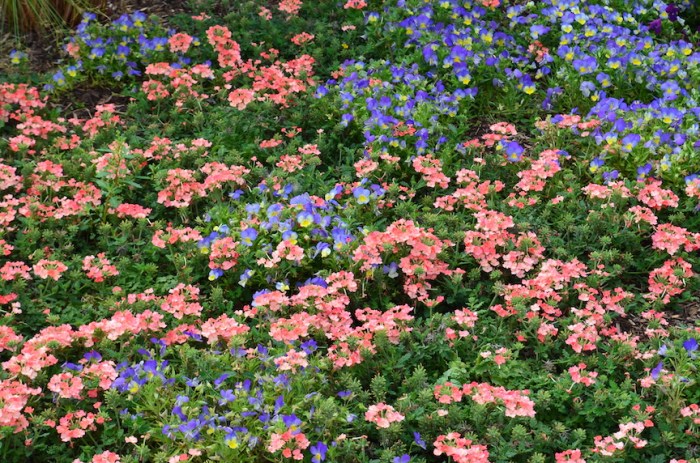
Peach Superbena and purple/yellow pansies are planted together in bright ground-covering swirls.
Years ago, I attended a plant trials event by Landscape Ontario (the province’s horticultural trades association) and was captivated by a gorgeous sweep of flowers (shown above) in vibrant peach and purply blue. The term “tapestry lawn” hadn’t been thought up yet but a brilliantly coloured mix of flowering plants working as a ground cover was definitely being researched.
For this exciting tapestry-effect planting, two Proven Winners products were used, still available today–Superbena® Peachy Keen and Anytime® ‘Iris’ Pansiola. For two plants that couldn’t look more unalike, they share a lot of the same attributes and that’s the key to a successful tapestry lawn. Both grow to about the same height and are heat tolerant. Both bloom continuously for most of the growing season and neither need dead-heading.
Creating a good looking and well behaved tapestry lawn simply takes a little match-making. Pick plants that all thrive in your gardening zone and require the same sun exposure and moisture requirements. Extra bonus points for finding plants with a trailing or vining habit. They’ll quickly weave your tapestry look together. Pun intended.
2. Go quietly gorgeous with a golden brocade
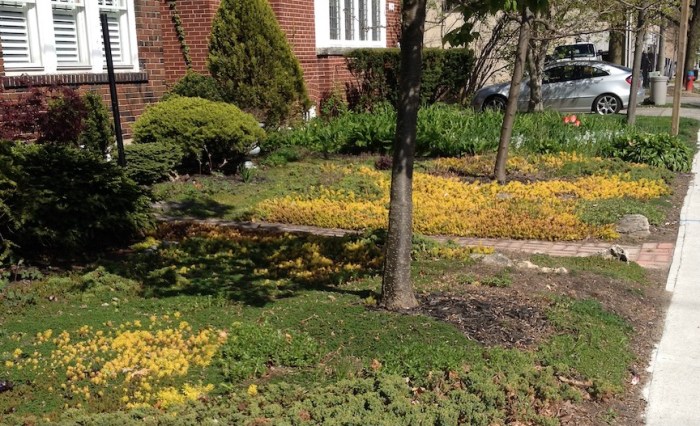
A front ‘lawn’ in Oakville, Ontario, glows in gold and greens with oodles of texture.
If a vibrant tapestry is a bit too much for you, go for a more toned down but equally sumptuous brocade. Choose two analogous colours (colours that sit side by side on a colour wheel) rather than complementary colours (colours that are opposite each other on the colour wheel). Greens and yellows not only fit the bill, there are a gazillion ground cover plant choices in these hues. The garden seen above has added even more interest with a variety of finely textured evergreen plants including prostrate conifers.
3. Sink into a subtle sedum tweed

This ‘lawn’ in Gananoque, Ontario, is a thick mat of creeping sedums.
If you’re looking for something even more subtle, then a luxurious tweed is your answer. A mix of creeping sedums, also known as stonecrop, can intertwine into a gorgeous weave of texture and colour. They can trail up to three feet in diameter, gradually knitting together into a dense, cushy mat. But it’s the choice of colours and textures that will have you sold. Creeping sedum foliage can be had in green, yellow, red, blue, silver or variegated. You can get leaves that are rounded or pointy. And they can sprout blooms in yellow, orange, pink or white.
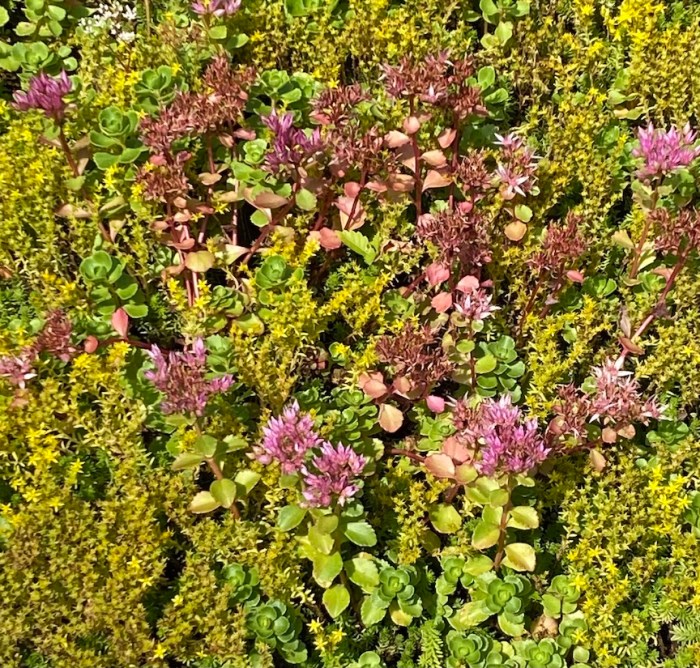
A detail shot of the Gananoque front yard showing the rich melange of sedums.
Although I’m not 100% sure, I’m thinking two of the sedums shown here are the pink flowering Sedum spurium ‘John Creech’ and the yellow star-spangled Sedum sexangulare. Interestingly, the latter is a native of Europe and southwestern Asia but has escaped to naturalize in parts of Ontario as well as some upper midwest states in the U.S. The tiny, bright yellow five-petal flowers appear from June to August.
Another interesting option for a tweedy effect that has a low or even lower profile and works well around paths or patios is a plant category marketed as “stepables”. These are hardy little gems that can withstand light foot traffic such as Woolly Thyme, Dwarf Chamomile, Scotch Moss and Dwarf Mondo Grass. So you can roll out the tapestried carpet for family and friends, too.
So how eco-friendly can a tapestry lawn be?
That depends. Building a collection of plants that are all drought tolerant and don’t require fertilizer is a great start. But there are other ways you can maximize your tapestry’s good-for-the-earth-ness.
- Choose pollinator plants such as white clover (attracts bees).
- Find as many native plants as you can. For Canadians, look for Bunchberry Dogwood (Cornus canadensis) or wild Strawberry.
- If your tapestry lawn is on a slope, choose plants known to help with erosion control such as Mouse Ear hostas.
Now throw on some accent pillows.
So you’ve decided to upholster a portion of your garden with a tapestry, a brocade or a chic tweed. If you’ve gone that far, you might as well add some clematis pillows. Yup, low mounding ‘pillows’ of gorgeous clematis blossoms. I’ve got the how-tos right here.


 Ministry of the fence
Perfect timing. Emma’s partner’s two litt
LikeLiked by 1 person