I read somewhere that this coming full moon (March 14) has quite the interesting name. Or actually, two names. It got the moniker Worm Moon from indigenous peoples in southern North America who noticed that this time of the year is when you start to see the first signs of life (well, insects and invertebrates) as the soil warms in spring. Here, in Fernie, British Columbia, earthworms would have a hard time negotiating the snow and ice that’s still crusting the ground. (Northeastern North American indigenous peoples called this moon the Crust Moon instead for good reason.) But I did see a fly the other day.
Here’s the really interesting part: This year’s Worm Moon is going to transform into a Blood Moon.

Sunset along the central coast of California, shot in November, 2017.
This coming Worm Moon is going to experience a total lunar eclipse which turns a normally bright full moon into a deep golden red, hence its second name.
Although traditionally there’s always a ‘Blood Moon’ each fall, this spring’s Blood Moon is a one-off because of that eclipse. NASA explained why this happens in surprisingly poetic terms stating that even though during the eclipse the moon will be in full shadow it’s “the glow of all of the sunrises and sunsets on Earth” that will give the moon its dramatic colouring.
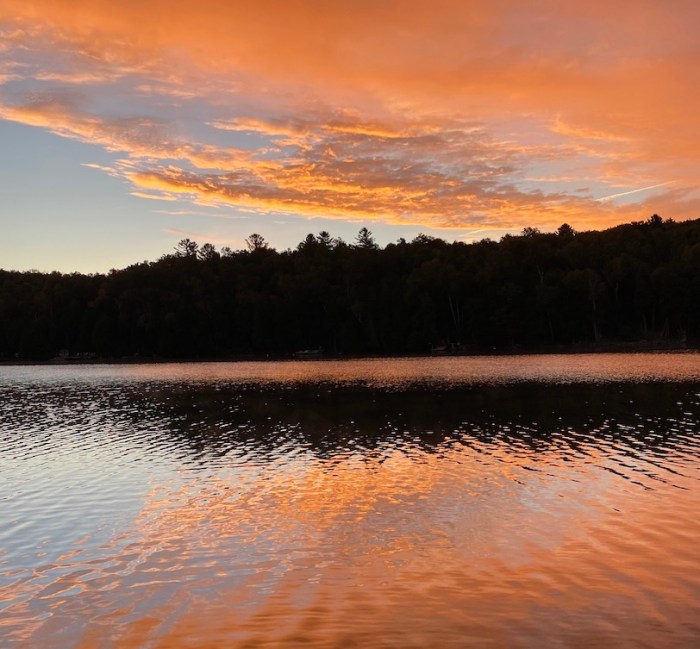
Sunrise over Bass Lake, Ontario, summer, 2023.
According to EarthSky, this total lunar eclipse will be travelling across parts of the globe and should be visible not only in the Americas but also the western half of Africa, western Europe, eastern Australia and northern Japan among other places.
Here are NASA’s timing details (which, I have to assume, will only be helpful for denizens of North America). All times are EDT. Check out EarthSky for alternative timings including UTC (Coordinated Universal Time).
Thursday, March 13, 11.57 p.m.: The Moon will begin entering the partial shadow.
Friday, March 14, 1:09 a.m.: The gradual dimming of the Moon will start to become noticeable.
Friday, March 14, 2:26 a.m.: The round shadow of Earth will gradually shift across the face of the Moon (from lower left to upper right) until the Moon is fully shaded.
Friday, March 14, 2:59 a.m.: The period of full shadow, or total eclipse, will last about 65 minutes, reaching the greatest eclipse at 2:59 a.m. and ending at 3:31 a.m.
Friday, March 14, 3:31 a.m.: The Moon will exit the full shadow of Earth, with the round shadow again shifting across the face of the Moon (from upper left to lower right) until 4:48 a.m.
Friday, March 14, 6 a.m.: The Moon will leave the last of the partial shadow ending this eclipse.

Sunset over Lake Huron from the beach in Southampton, Ontario, shot in November, 2024.
Sunrises and sunsets are such wonders and, happily, are pretty easy to enjoy. I love snapping them wherever I might be, as you can see. But what happens between sunset and sunrise can be just as shockingly beautiful. I’m going to try to witness this Worm/Blood Moon although I have to admit that setting my alarm for 1 a.m. (we’re on Mountain Time) may seem like fun now and unthinkable come March 13th. And then, of course, there’s the chance that dense cloud cover will make any kind of viewing impossible in any case.
But even if our skies are filled with snow-loaded clouds and I snore right through the whole shebang, just knowing that this extraordinary moon will be quietly, spectacularly spreading the glow of a million sunrises and sunsets over our sleeping heads seems like an affirmation. We live in strange, worrisome times and yet there are inarguably bigger, beautiful, humbling experiences all around us.


 Ministry of the fence