Yes, it’s a little early to start talking about mowing the lawn. In parts of Ontario, upwards of 10 feet of snow will have to melt away first. But something exciting in the world of mowing has been reported and I just had to share. Really.
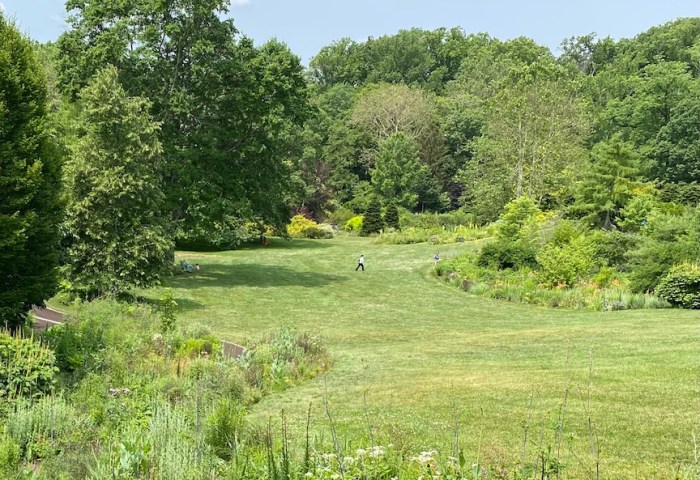
A large swath of grass lawn at Chanticleer, Pennsylvania, USA.
It turns out that mowing in random curves rather than in straight lines can actually enhance biodiversity and encourage an increase in the number of butterflies and bees.
A team of scientists and researchers in Belgium worked with farmers growing hay over several years and discovered that curvy-mown meadows showed an increase of bees by about 40%.
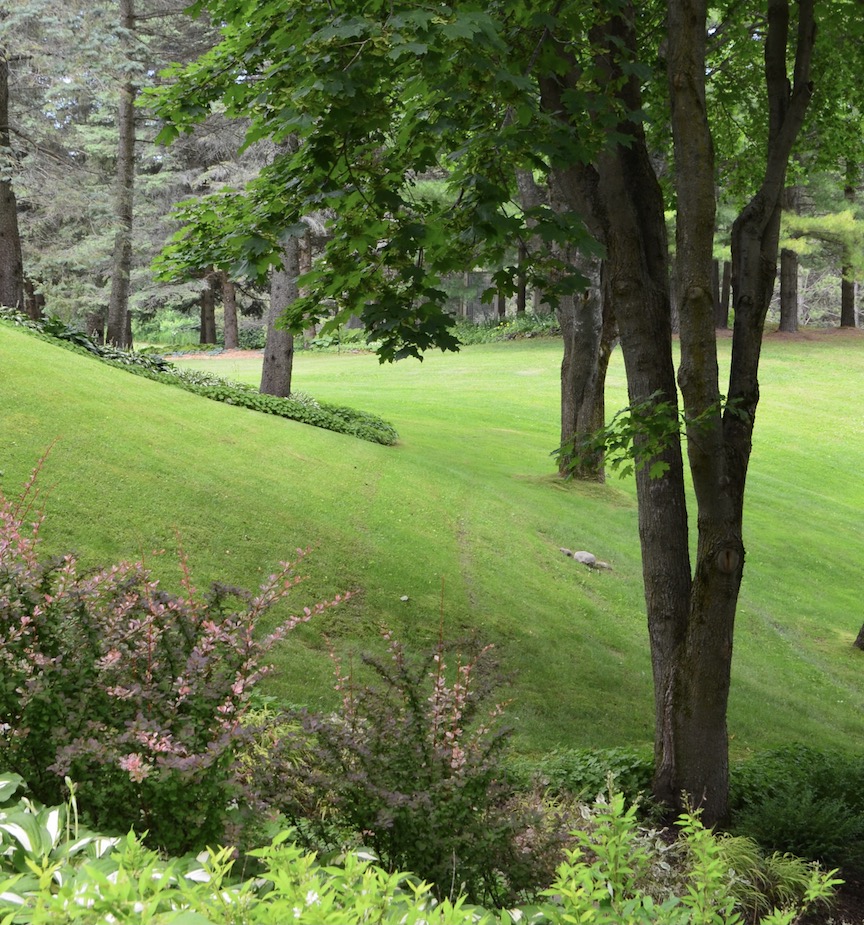

Left: A large private garden north of Toronto. Right: A view of the arboretum at Longwood Gardens in Pennsylvania.
How exactly this works is a bit beyond me. But I don’t care. I immediately thought of all those huge lawns in rural Ontario. I’ve seen lawns that rival farmers’ fields in scale. Why they’re that big is a mystery to me. (Although when I see a property owner buzzing about his/her ginormous lawn on one of those muscular ride-on mowers with the built-in speaker system and the extra large cup holders to hold your Big Bubba thermal beverage container I begin to understand.)
Wouldn’t those huge lawns look extra wonderful if they had a subtle wiggle to them? And just the thought that those wiggles could be encouraging more bees and other beneficial insects, well, why not?
Where the wiggles work
This radical notion isn’t perfect, of course. And it’s still in the experimental stage for professional land managers. There are both pros and cons for farmers, in particular. Kinks will have to be worked out (pun intended). But experts agree that this could be a potentially easy ‘win’ for conservation managers of parks, reserves and specially protected lands. Urban parks and strips of grasslands around golf courses could also benefit. But here’s the clincher:
You can get the whole story which “highlights the power of imperfection” (love that!) in the article “Put some wiggle in your mowing. Bees will love it” on the Science website.

At a home north of Toronto, a large portion of the property is devoted to un-mown wildflower meadow framed by mown lawn.
How to try this at home
Of course, suburban lawns are often monocultures that are notoriously unfriendly to wildlife. But lawns can, in their own way, be beneficial. If you want to really make a go of upping your pollinator population with your lawn, try:
- Opting for a blend of turf grass seed with wildflower seeds and or Micro-Clover.
- Adjust your mower to cut higher so that in addition to mowing like a drunken sailor, you’re leaving a slightly taller lawn.
- Leave some parts of your lawn un-mown (see the example above) to encourage even more critters to move in.
Who knew that cutting your grass as if you’d had a few too many cocktails can actually boost the amount and diversity of pollinators? Cheers to that.


 Ministry of the fence