Over the last few days our little town of Fernie in southeastern British Columbia has been buried under a thick blanket of snow. Driving is a horror show but, man, everything looks so pretty. The colours of our town, the woods and surrounding mountains have receded or vanished in the glare of a whiteness so bright only shadows and dark shapes remain. Except for our wonderful Mountain Ashes.

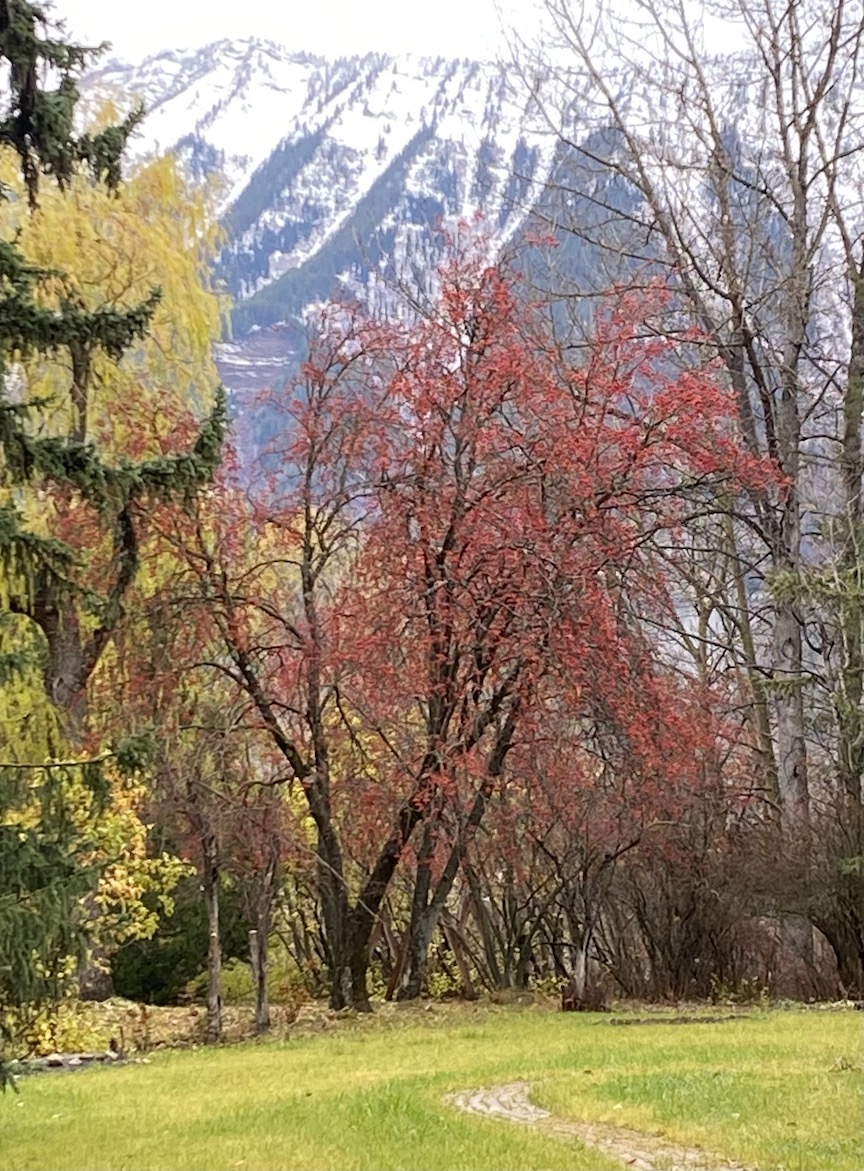
Two views of Mountain Ashes in Fernie gardens in mid-November, 2024.
Just a couple of weeks ago, I took the photos seen above. Fernie is blessed with an abundance of Mountain Ashes, both invited and uninvited. Some people have described these trees as ‘garbage trees’ which is harsh, to be sure, but unflinchingly to the point. Granted, ashes are everywhere here. But they are also everywhere elsewhere and have even been considered invasive in some parts of the world. I think ‘our’ trees, here in Fernie, are Sitka Mountain Ash (Sorbus sitchensis), native to Alaska and the Pacific Northwest all the way down to northern California and east across southern British Columbia.

A snow-covered Mountain Ash in the front garden of a home in Fernie, Noveber, 2024.
Mountain Ashes are fantastic in the fall, as you can see. But I think they really come into their own in winter after a snowfall. Their leaves fell off days ago and only their bright red berries, dangling in clusters, are left. As the snow falls, the clusters are decorated with adorable little snow cone hats.
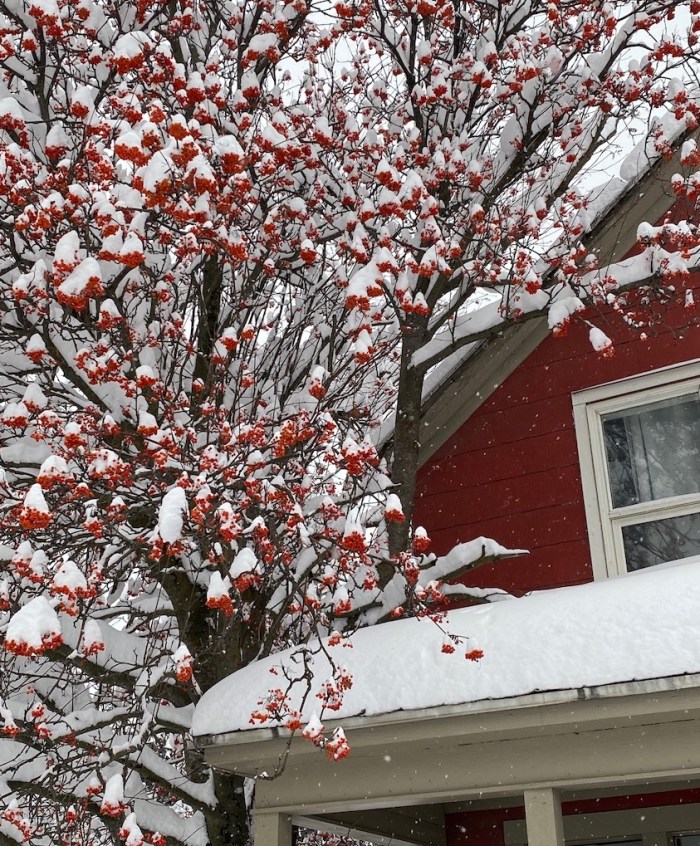
It could be coincidence that this Fernie homeowner perfectly matched their house to their Mountain Ash’s berries but I like to think it was planned. Shot November, 2024.

These little snow caps can grow quite tall. November, 2024.
Native or not or not an ash at all
Finding an ash for your own garden can be a tad tricky (unless you live in Fernie where the chances of you already having one or three in your garden are pretty good). Canadian garden centres often offer European Mountain Ash (Sorbus aucuparia). It often escapes and can appear to be a native.
If you want a Canadian native, you’ve got choices:
• If you live in western Canada, there’s the aforementioned Sitka and Greene’s Mountain Ash (Sorbus scopulina) which also goes by the names Cascade Mountain Ash and Western Mountain Ash.
• If you live in eastern Canada, look for American Mountain Ash (Sorbus americana) or Showy or Northern Mountain Ash (Sorbus decora), both native from Ontario to Newfoundland.
Interestingly, Mountain Ash isn’t an ash at all, technically. Real Ash trees (Fraxinus species) are the ones that are susceptible to decimation from the emerald ash borer. Mountain Ash aren’t. If you want the real deal, both White Ash (Fraxinus americana) and Green Ash (Fraxinus pennsylvanica) are natives of Eastern Canada.
Oh, deer!
Besides being a gorgeous tree, in my opinion, Mountain Ashes are also a terrific support to wildlife in winter. This may or may not be a good thing depending on your tolerance for large, wild mammals.
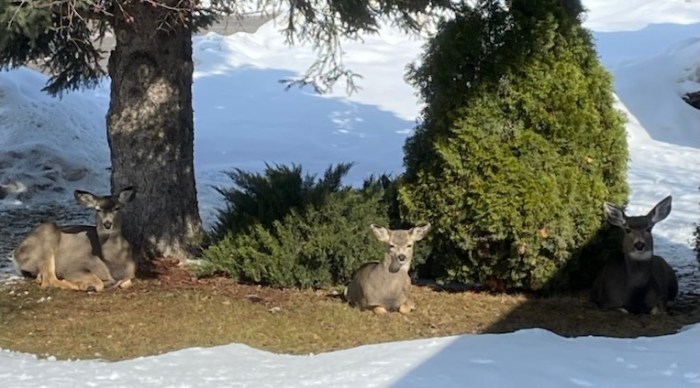
Three deer hanging out and trying to appear innocent in my step-daughter’s front garden in Fernie, B.C.

Deer in Fernie, B.C., foraging for Mountain Ash berries and even standing on their hind legs to reach them (seen at far right).
Mountain Ash berries can be deer magnets. Birds love the berries too, of course, but deer treat Mountain Ashes like a smorgasbord served at a slightly inconvenient height. Maybe it’s a Fernie deer thing, but I’ve seen many of them simply rear up on their hind legs and munch (as you can see in the above photo).
This kind of behaviour can either be seen as interesting or a nuisance. Their visits seem harmless enough to me but I haven’t had a herd come through my garden and prune my trees whether I like it or not. SIDE NOTE: A group of deer wandering through town is a fairly common occurrence in Fernie and usually tolerated. However, ‘our’ deer have unfortunately yet to distinguish trails from streets and stop signs from inedible trees so they can be a danger, especially if you drive around a corner and suddenly find a four-legged traffic jam.
But consider a Mountain Ash in any case. Those snow-capped berries are worth it.


 Ministry of the fence
Pingback: Winter critters and colours | Ministry of the fence
Pingback: For ever greens, indoors and out | Ministry of the fence