At this time of year in North America, small red paper poppies are pinned to coats. It’s a solemn reminder and yet a lovely gesture, I think. Why the poppy? By the end of WWI, much of Western Europe had been decimated and much of the countryside had been transformed into barren fields of mud where nothing, it seemed, grew any more. Except the poppy. In particular, the bright red Flanders poppy. Lieutenant Colonel John McCrae, a Canadian doctor, was struck by the sight and wrote the poem ‘In Flanders Fields’, with the bloom eventually becoming the powerful symbol we know now.
In Flanders fields the poppies blow Between the crosses, row on row…

Red and purple poppies in a garden in south central Ontario, shot in July, 2022.
The iconic red Flanders poppy (Papaver rhoeas) is still available and easy to grow. Vancouver-based West Coast Seeds sells the heirloom seeds. Besides the meaningfulness of them, these poppies are wonderful additions to a garden just because they are so low maintenance.
- Flanders poppies are very drought tolerant.
- They’re an excellent addition to a xeriscape.
- They grow to a height of about 2 feet.
- A hardy annual, Flanders poppies will self seed.
- They play well with other flowers and look particularly striking with ornamental grasses.
You can direct sow the seeds and, if you happen to live in Garden Zones 8 – 10, the best time to do that is right now, in late fall.

Photo taken at Chanticleer gardens in Pennsylvania, U.S.A. in June, 2023.
Like zinnias, poppies come in a breathtaking range of sizes, shapes and colours. Besides the classic Flanders Poppy, there is the Iceland Poppy (Papaver nudicaule) which lights up a garden in vibrant shades of orange, gold, and peach. I love the adorable, bright orange California Poppy (Eschscholzia californica) . What it lacks in height it makes up for in eye-searing colour. And it self seeds generously. Bonus: it’s another great poppy for direct sowing either in fall or spring.
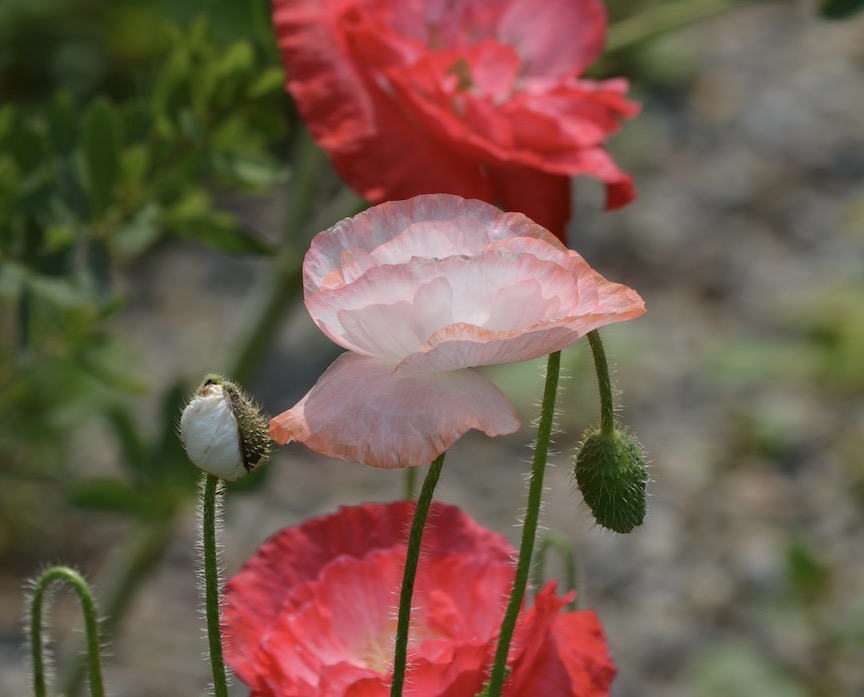
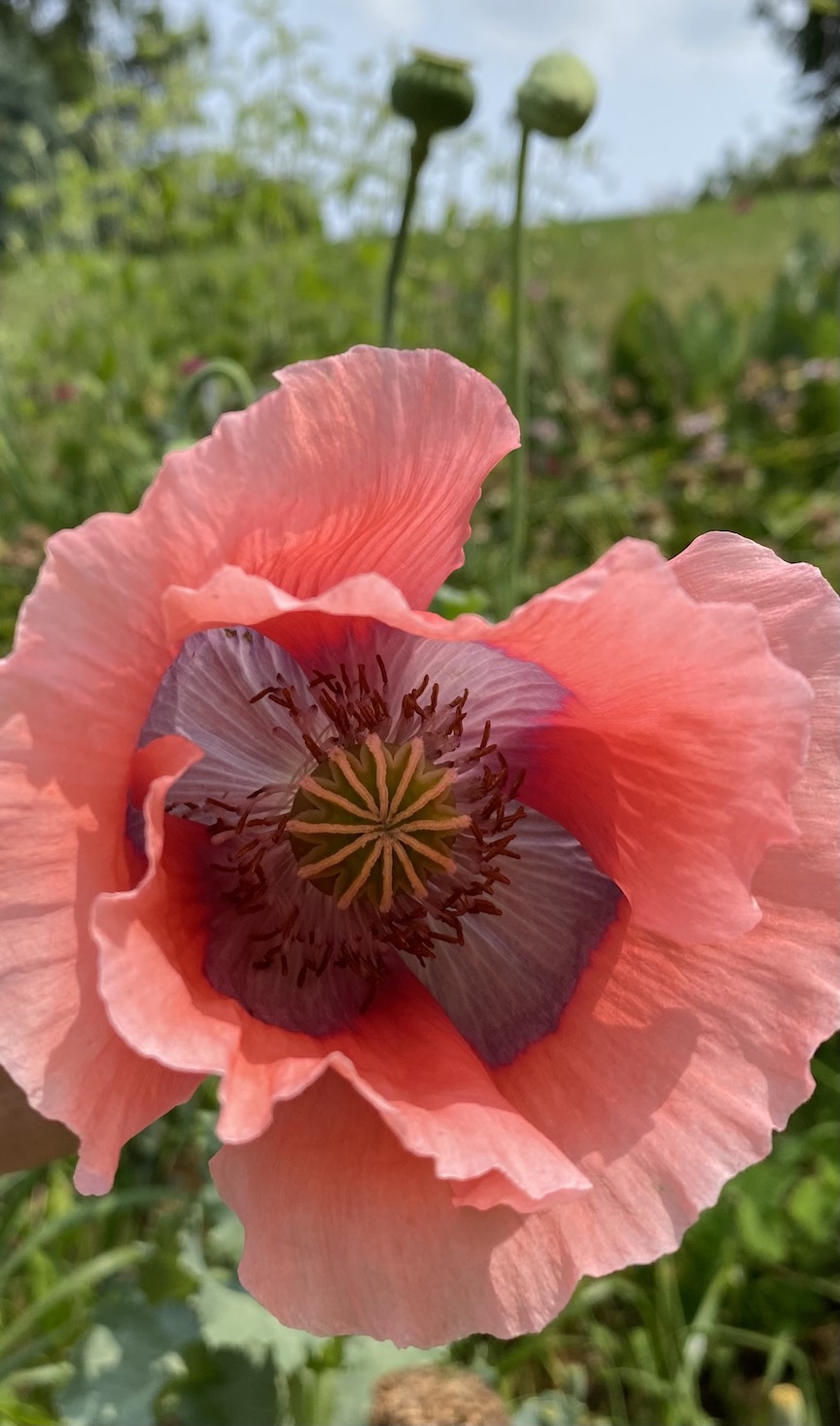
Photos taken at Chanticleer gardens in Pennsylvania, U.S.A. in June, 2023.
Oriental poppies (Papaver orientale) are recognizable by their large, papery blooms in gorgeous shades of red, pink, mauve and peach. I always think of ballgowns when I see a bunch of them. Check out the fabulous selection of mail-order Oriental Poppies at Brecksbulbs.ca.
The Himalayan Blue poppy (Meconopsis betonicifolia) is one of those spectacular garden plants that requires an experienced hand and, I’ve heard tell, is not easy to grow, but will give the grower impressive bragging rights if successful. The flower is an astonishingly true blue. If you happen to be near the Gaspe Peninsula in Quebec from mid-June to the end of July, I urge you to check out Reford Gardens (also known as Jardins de Metis)–one of Canada’s most important botanical gardens and home to the renowned Blue Poppy Glade as well as Blue Poppy Trial Beds.
In Canada, you can order Meconopsis ‘Lingholm’ in pots in the spring from Phoenix Perennials.

Photo taken in Gananoque, Ontario, in July, 2022.
There’s also something to be said for a poppy’s wonderful seed heads. They certainly add interest in the garden bed long after the flowers have faded. If seed heads are a big thing for you (they are a boon to the late fall garden) then you have to check out Giganthemum poppies. Papaver somniferum offers blooms that are huge and seed heads that are insane. We’re talking the size of a tennis ball. Evidently, the seeds are edible and terrific for baking.


 Ministry of the fence
Welcome back to Fernie-so enjoy your writing!
LikeLiked by 1 person
Thanks, Kathy!
Very happy to be back. Cheers!
LikeLike
Meconopsis is one of my most favourite genera, and living in the damp north west of England on acid soil I was lucky enough to be able to grow them, although Scotland is the place they really flourish. Perhaps you would like to see those that I have grown at: https://ricksplantworld.blog/2022/02/09/meconopsis/
LikeLiked by 1 person
Wow! I’m so impressed with all the gorgeous blue poppies you’ve grown, Rick! Thanks for sharing the link to your post. I encourage anyone reading his comment to check out Rick’s page. The photos are wonderful showing a great variety of blue poppies as well as other kinds, too. Just astonishing!
LikeLike