I have a couple of Cup Plants growing in amongst wild grasses and Blue Flag Irises, down by the water’s edge of the small lake where we live in southern Ontario. A garden this is not. I added the irises and the Cups in an attempt to add a little colour to the one and only patch of ground on our property that gets some sunlight. The irises are doing well but the Cup Plants not so much. I totally put them in the wrong spot. But they’re not concerned, moving towards the sunlight of their own accord. This, unfortunately, means my Cups are running (albeit very slowly) at a full horizontal. Not the most dignified position for a statuesque flower.
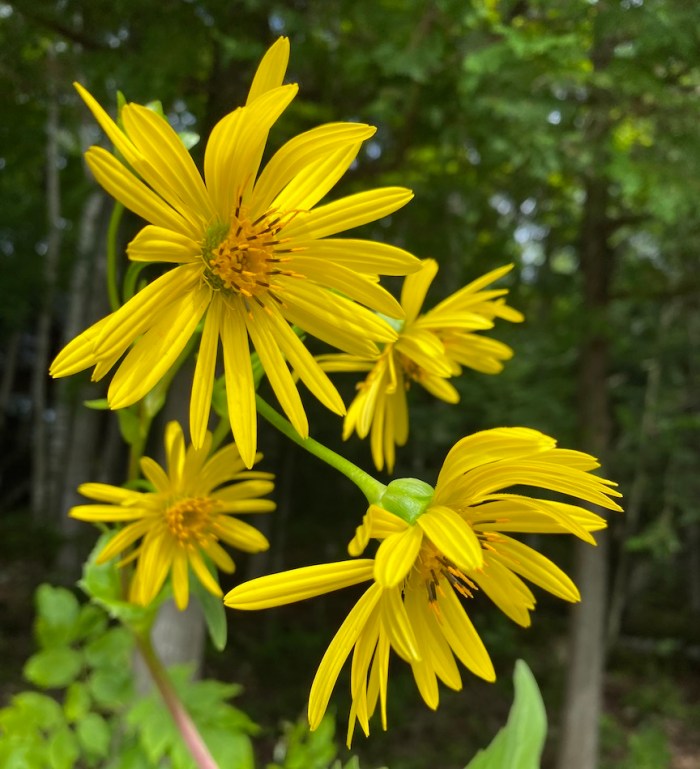
My Cup Plant blooms in early August of this year.
Cup Plant (Silphium perfoliatum) is a native herbaceous perennial to a great swath of the American plains as well as bits of southern Ontario. It’s a close relative of the sunflower and it’s not hard to see why. The tall, reddish stems, square and sturdy, carry bright yellow blooms up to 9 feet high.

A big patch of Cup Plant growing at Earthbound Gardens on the west coast of the Bruce Peninsula in Ontario. Shot mid-August, 2024.
This gorgeous plant blooms abundantly from July through September but I have to admit it isn’t the flowers that I’m most intrigued by. Pairs of leaves (leaves as big as your hand or larger) join at the stem to form a cup. After a rain, you’ll see these cups holding aloft tiny pools.
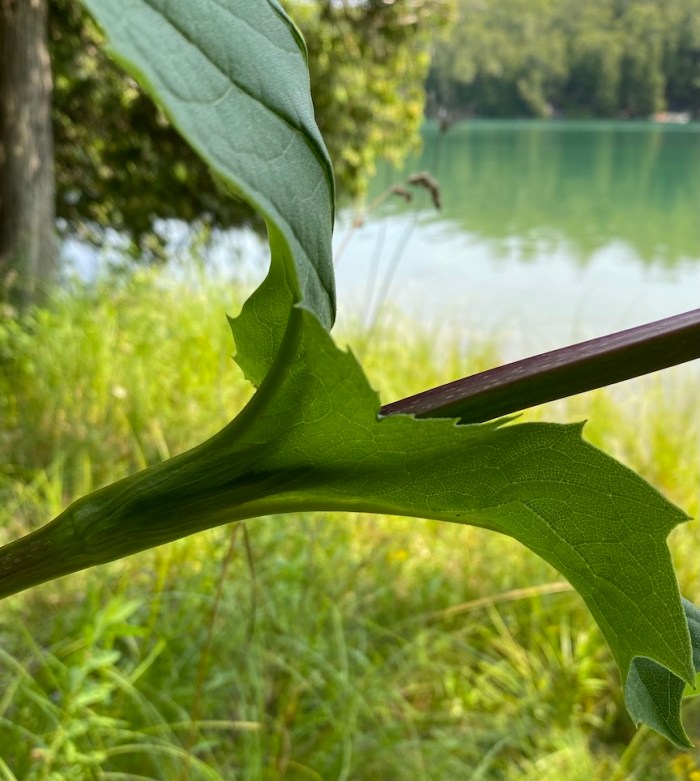
A close-up of the base of a pair of leaves clasping the square stem to form a cup.
Birds, especially hummingbirds and goldfinches, love to quench their thirst from these cups. The plant helps an impressive assortment of other kinds of wildlife, too. Bumble bees and Honey bees raid the plant for nesting materials and short-tongued bees, wasps and flies visit the flowers for pollen and nectar.
Agriculturalists, take note: The Ontario government has studied Cup Plant as a possible forage crop for domestic livestock and found it compares well with corn silage.


My Cup Plants are wild and weird but they light up this patch of sunlight, contrasting beautifully against the dark shade of the woods behind.
Earlier this summer, I saw a huge stand of Cup Plant in the small front garden of an urban home in west Toronto. It was certainly eye-catching but I have to say it did look a little like an elephant trying to pass itself off as a puppy. Cup Plant really needs space. A large garden with a meadow, wildflower, prairie or woodland feel would be ideal.
Despite those awesome square stems, Cup Plant can start to lean or fall over once it’s carrying all those blooms at its full height. High winds can shove these plants around as well. A support of some sort will definitely keep your Cup Plants tall and proud.
They are wonderful situated along the edge of a woody area but keep in mind that this plant needs full sun. If you put it in the wrong spot like I did–edge of a woody area but embraced on both sides by trees further limiting sun exposure–it’ll let you know in the most unsubtle way (see below).
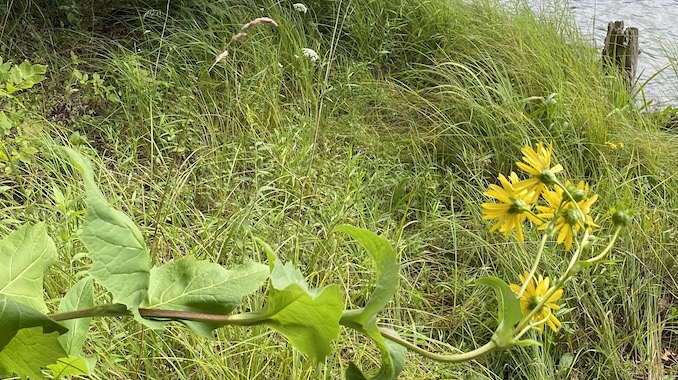
One of my lurching Cup Plants, clearly pining for the sun.
But don’t let me put you off this wondrous plant. It’s easy to grow (if you put it in the right spot), tolerates most soils and needs very little care once it’s established. It’s drought resistant and, remarkably, flood tolerant, too. Growing a larger patch isn’t a problem either. One or two plants can get you started and then they take it from there, self-seeding shamelessly. They’re also as easy to propagate as hostas–Just chop off a section of the rhizome and replant.
Here’s a quick video from that gives you an overview of the plant as well as some great visuals of the largeness and wonderfulness this plant.
Canadians can order Cup Plant seeds through Ontario-based Wildflower Farm.


 Ministry of the fence
Pingback: Little, big (and wild) sunflowers | Ministry of the fence