In my travels this summer I’ve been noticing that the plants that really stood out for me weren’t necessarily bright (although there’s something to be said for hot colours in the summer garden). But show me a plant or a group of plants with extraordinary texture and I’d stop in my tracks. Here are 5 of my faves, discovered in Ontario gardens this June and July.
The shaggy cedar
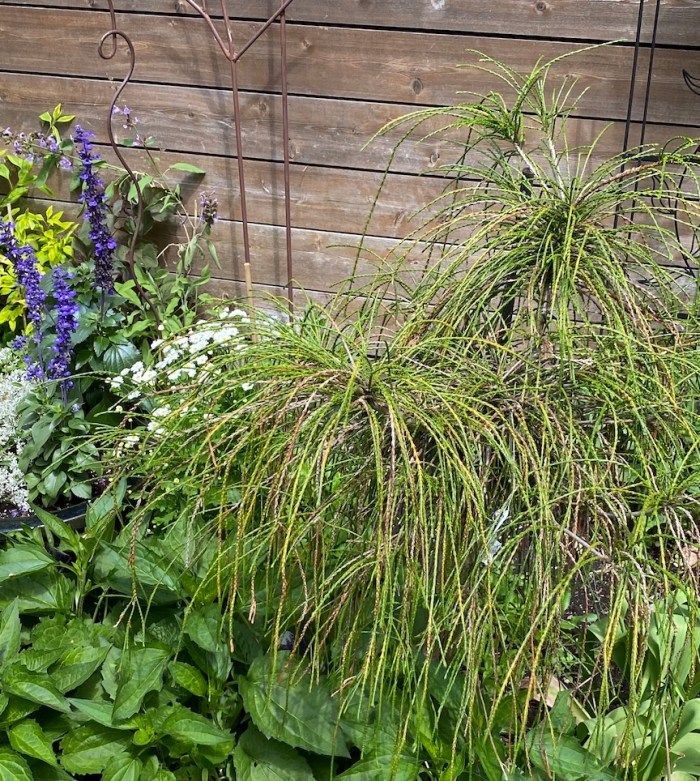
The shaggy green mopheads of a Whipcord Red Cedar in an urban garden in west Toronto.
Looking like a green version of Cousin Itt, Whipcord Western Red Cedar (Thuja plicata ‘Whipcord’) flings out cascading stems covered in teeny tiny leaves like scales that give them a wonderfully textured look. Although “Red Cedar” sounds like this cute-y will eventual grow into a towering monster, it’s actually a shrub that peaks at 4 to 5 feet tall and wide. Bonus: the foliage turns bronze in winter.
Plant in full or part sun and let the surface soil dry out between waterings.
Canadians can order this plant through Ontario-based PlantCentral.ca.
The shrub with quilted leaves
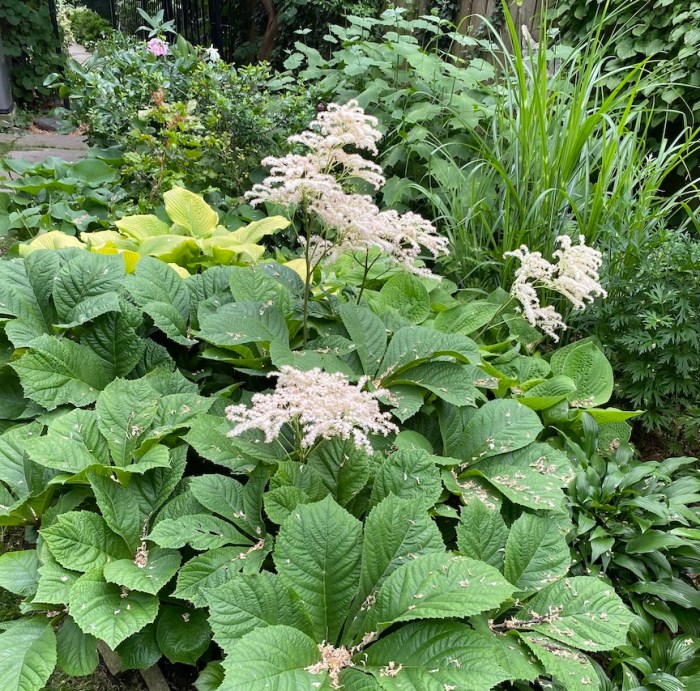
A Chestnut Rodgersia in an urban garden in west Toronto.
Rodgersias are a fairly common garden choice, I admit. But I was struck by the extra sumptuous texture of this Chestnut Rodgersia (Rodgersia aesculifolia) reminiscent of the horse chestnut tree. A herbaceous perennial native to China, this shrub is pretty well behaved here in Canada, growing up to three feet tall and five feet wide.
Also check out Bronzeleaf Rodgersia (R. polophylla) with its extra crinkly leaves that are lobed with extra spiky edges and a gorgeous dark green colouring flushed with a kind of metallic chocolate. ‘Chocolate Wing’ Featherleaf Rodgersia (R. pinnata ‘Chocolate Wing’) has deeply quilted leaves that put on a colour show of their own from spring through fall, morphing from dark brown to green to bronze to red and then back to brown.
Plant in part shade to shade. You may feel the need to cut back the fading leaves in late fall. If you do, make sure you remember the location of the plant’s crown and don’t accidentally tread on it as the plant all but disappears in winter.
Canadians can order this plant in spring through Ontario-based BrecksBulbs.ca and Green Haven Garden Centre in Lethbridge, Alberta.
The exploding bloom

An exploding Allium schubertii in an urban garden in west Toronto.
This wonderful ornamental onion gives a sense of motion as well as texture in a garden. I mean, how can you not think of an exploding star when you first see it? Up to a hundred little purple florets bloom from the supernova of stems from late spring to early summer.
Also try Hair allium (Allium vineale ‘Hair’) which looks a little like Schubertii if it had accidentally poked one of its leaves into a live electric socket.
Plant these bulbs in the fall in full sun in average soil. They’re pretty hardy, growing in Canada zones 3 – 9 but they’ll benefit from a protective layer of mulch come fall.
Canadians can order Schubertii Allium through Prince Edward Island-based Veseys and Breck’s.
The furry annual

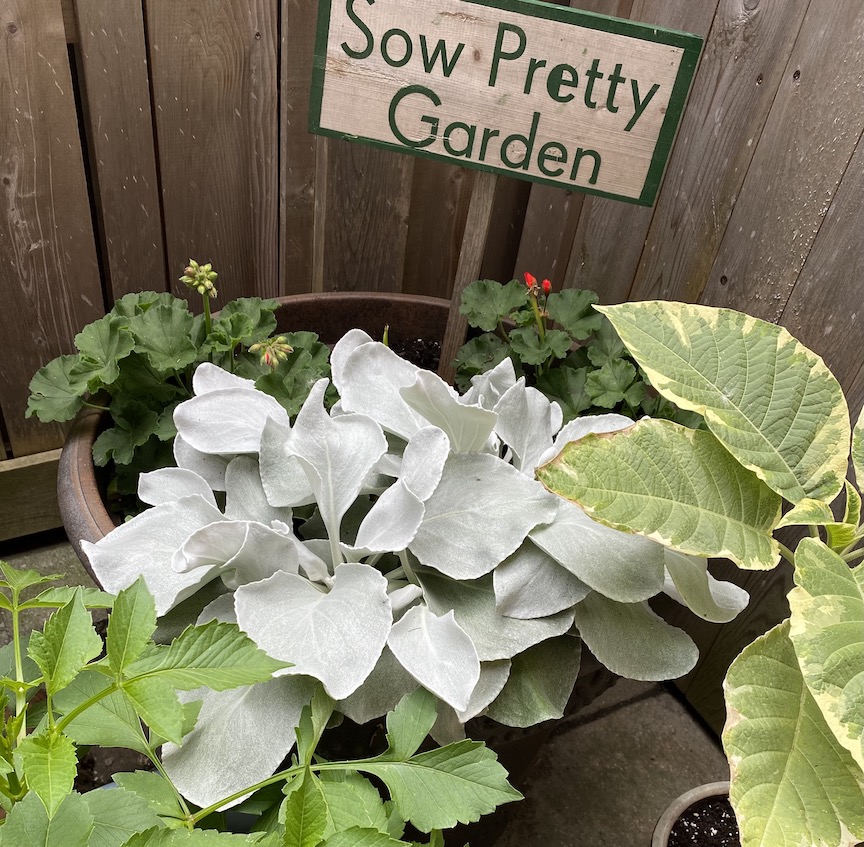
Two Senecio candidans I discovered on garden tours in Toronto and Gananoque.
As soft as Lamb’s Ear (Stachys byzantina) but with leaves way larger and glowing with a whiteness that borders on ghostly, Angel Wings is a real showstopper. I couldn’t believe my eyes when I first set sight on them. Originally hailing from Chile, Senecio candidans (also commonly referred to as the less lovely Sea Cabbage) is officially an evergreen perennial but since it will only tolerate winter temps down to -5C, most Canadians will need to treat this as an annual.
This plant loves a spot in full sun in free draining soil. In fact, it will be most unhappy in moisture-retentive soil so give the label on your potting soil a check before planting this one in a pot.
In Canada, you can order this plant through Green Acres Greenhouse in Watrous, Saskatchewan and Phoenix Perennials in Richmond, B.C.
Rhubarbs to fill a bed with texture
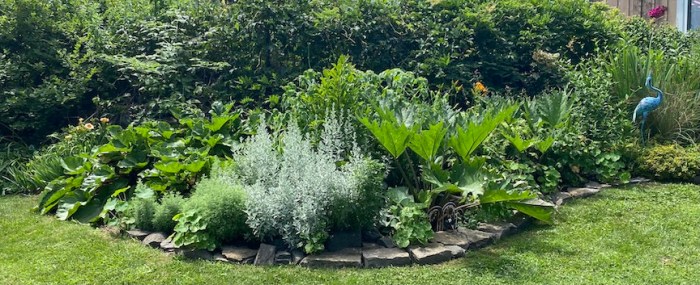
Rheum rhaponticum (left) and Rheum palmatum (right) with a lovely clump of silvery Artemisia front and centre in a garden bed rich with texture.
I didn’t realize ornamental rhubarb was a thing until I discovered this gorgeous garden bed on a tour near Gananoque, Ontario. The large primordial looking plant seen right of centre in the photo above is Chinese rhubarb (Rheum palmatum). It’s inedible but who cares? The leaves of this plant (shown in detail below) are absolutely glorious. To top it off (quite literally), the plant sports flowers like feathery plumes in cream or pink on towering stalks in late spring/early summer.
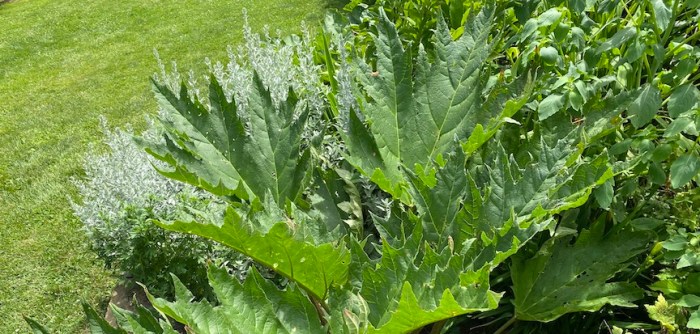
Rheum palmatum up close.
Also take a look at Rheum palmatum ‘Tanguticum’ which has the same deeply lobed leaves as above but they turn a spectacular wine red colouring in the fall. Tanguticum is also not edible.
Rhubarbs are hardy perennials that need full sun and average, moist but free-draining soil. If you have the patience of a saint you can grow them from seed but potted plants are available and recommended.
In Canada, you can order edible and ornamental rhubarbs through Nova Scotia-based Bunchberry Nurseries.


 Ministry of the fence
Pingback: Transporting the garden | Ministry of the fence