Of all the colours you can find in a garden, orange can be the trickiest, I think. As hues go, it can glow brighter than red or yellow all the while doing more clashing than complementing. It’s very much a shout out colour. But that’s what also makes it a great colour to have in mind when you want to wake up a part of the garden. Canada’s Communities In Bloom Association agrees, declaring orange the colour of 2024, encouraging gardeners across the country to “Plant orange!”
Here are 7 of my favourite plants that really deliver the zing in various garden situations.
The native that can hold its own in a sea of colour and texture.

Asclepias tuberosa sprinkled throughout a gravel garden at Chanticleer in Pennsylvania.
Bright orange Butterfly Weed (Asclepias tuberosa) is a native to almost all of the United States and the eastern half of Canada. It’s often confused with Milkweed (Milkweed has a milky sap, Butterfly Weed doesn’t) but both plants are butterfly magnets. The orange flowers are some of the brightest (as you can see above) and work particularly well when you’ve got a naturalized flower garden or a very large flower bed and need some hot colour to stand out and electrify the mix.
- Full Sun
- Dry or moist soil if well draining. Tolerates sandy soil well.
- Excellent drought tolerance
- Attracts butterflies (duh!) and hummingbirds
- Makes a great cut flower
Adding zing to a small garden with glam container stars.
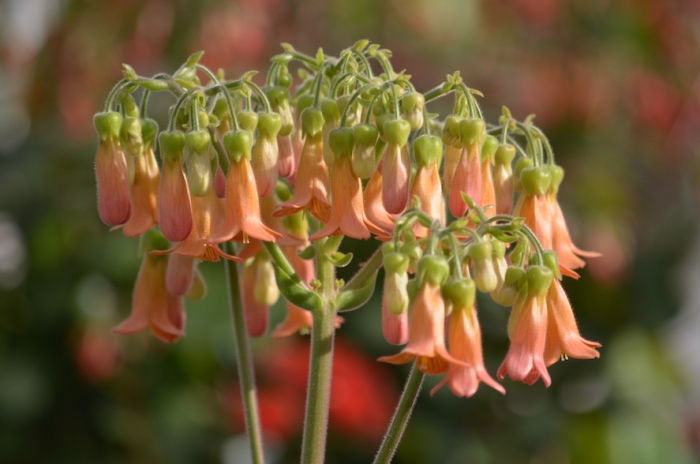
Kalanchoe pubescens shot at National Trust Wisley in England.
When you’re really tight on space sometimes all you need is a plant in a container strategically placed to multi-task as eye-catcher and focal point. But that plant as got to be YOWZA! Kalanchoe pubescens (shown above), fits this category perfectly. Gorgeous apricot bells dangle from tall stems that shoot up from a base of green-grey velvety leaves. But I have to admit it’s not easy to find available for sale. At least, not in Canada.
- Full sun
- Well-draining soil. Be careful not to over water.
- Treat as an annual
- Best as a container plant for easiest maintenance and to control the amount of water in the soil.
- Only add to the outdoor garden after nights are consistently 13C or warmer.

Sun Stars (Ornithogalum dubium) in a container planting at Chanticleer in Pennsylvania.
If you love the effect of a tall, elegant, bright orange flower but Kalanchoe pubescens is out of reach, try Ornithogalum dubium commonly known as Sun Star but also referred to as Star of Bethlehem. Hailing from South Africa, it’s easy to order through online Canadian plant retailers. Treat this plant as either an annual or as a houseplant that you let play outside during the warmest months of spring and summer. Do as the gardeners at Chanticleer do (shown above) and display a large, dish-like container of them on something akin to a pedestal for maximum drama. Not only will you have created an eye-catching moment but you’ll be erring on the side of caution as all parts of this plant are toxic to dogs, cats, horses and humans. The flowers spring up on tall stalks from bulbs and once the flowers are gone, you need to let the plant(s) go dormant.
- Bright but indirect light
- Fertile, well-draining potting soil
- Allow soil to dry between waterings. Once flowering has ended, reduce watering to a minimum.
- Keep well away from pets and children as all parts of this plant are toxic.
The flaming edible that makes an extraordinary ground cover.


Ornamental peppers grown in a large bed bordering a walkway at Royal Botanical Gardens in Hamilton, Ontario.
Ornamental pepper (Capsicum annuum) is an edible fruit but these little guys are bred more for their good looks rather than their taste. Many bear fruit in a range of colours that slowly change as the fruit matures so they’ll start out in one colour and, like a snail’s-paced light show, turn into another colour and then another until frost finally flips the switch. This makes for a truly unique option for ground cover and lining borders or a path. Try edging the path leading to your front door in ‘Sangria’ with peppers that evolve into different shades of bright orange, red and deep purple for a spectacular colour show to welcome visitors.
- Full sun
- Well draining soil
- Plants grow in clumps up to a foot high and wide. Don’t plant them next to plants that might cast shade on them as these guys need sun to set fruit.
- Don’t plant out until nights are at least 12C.
- Flowers bloom in mid-spring with fruits lasting to first frost.
The happy flower that spreads cheer. Everywhere.

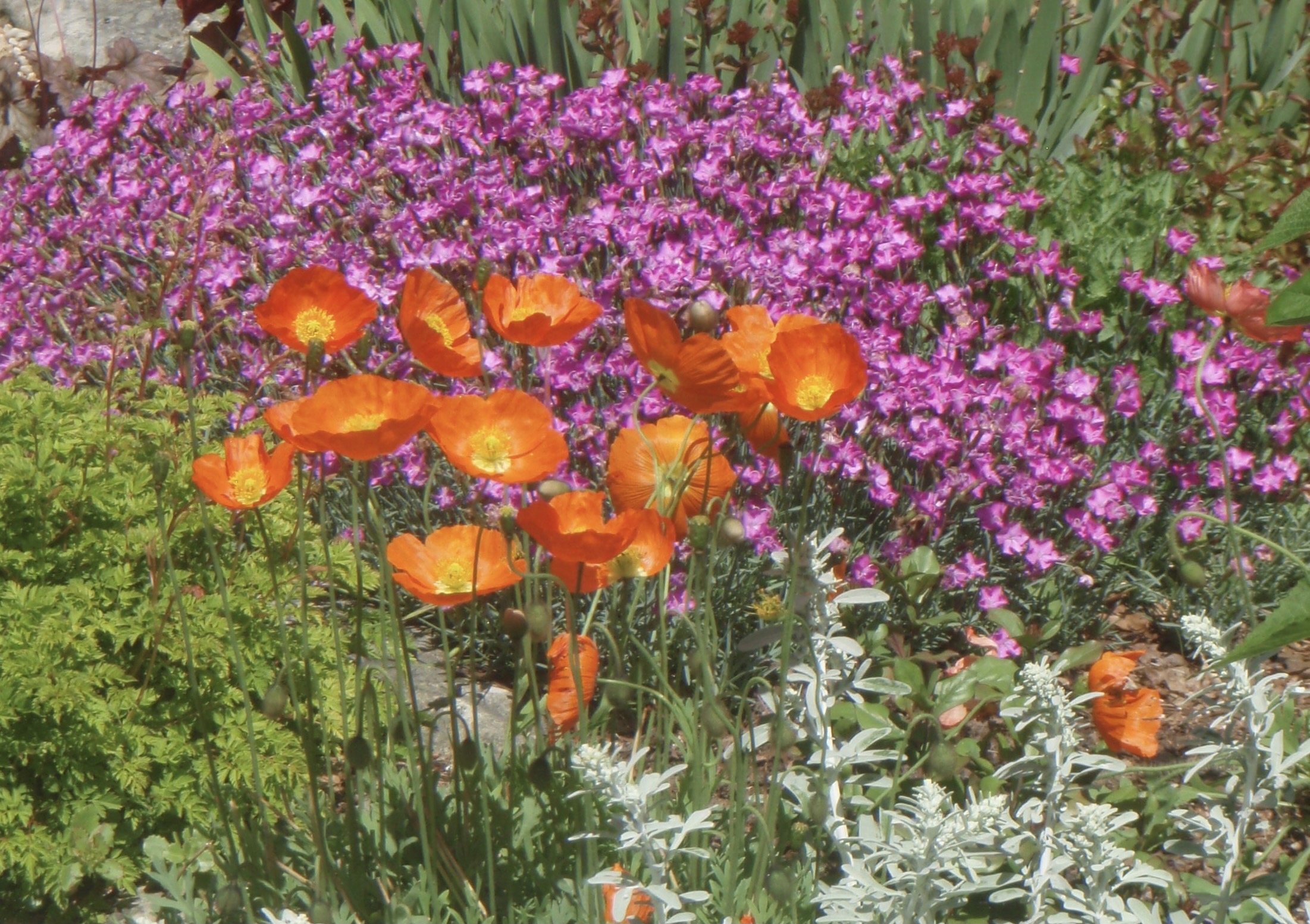
California poppies grown in a gravel garden in Toronto, Ontario.
If you love serendipity, you’ll love these cuties which will flower from early summer right through to the first frost. California Poppies (Eschscholzia californica) are famous for delivering loads of fiery colour. Although they’re native to California and Mexico, in Canada we treat them as an annual and can easily be grown from seed and also love to self seed once established.
- Full sun
- Well-draining soil
- Excellent drought tolerance
- Sow direct after last frost
The elegant lily that adds colour from great heights.
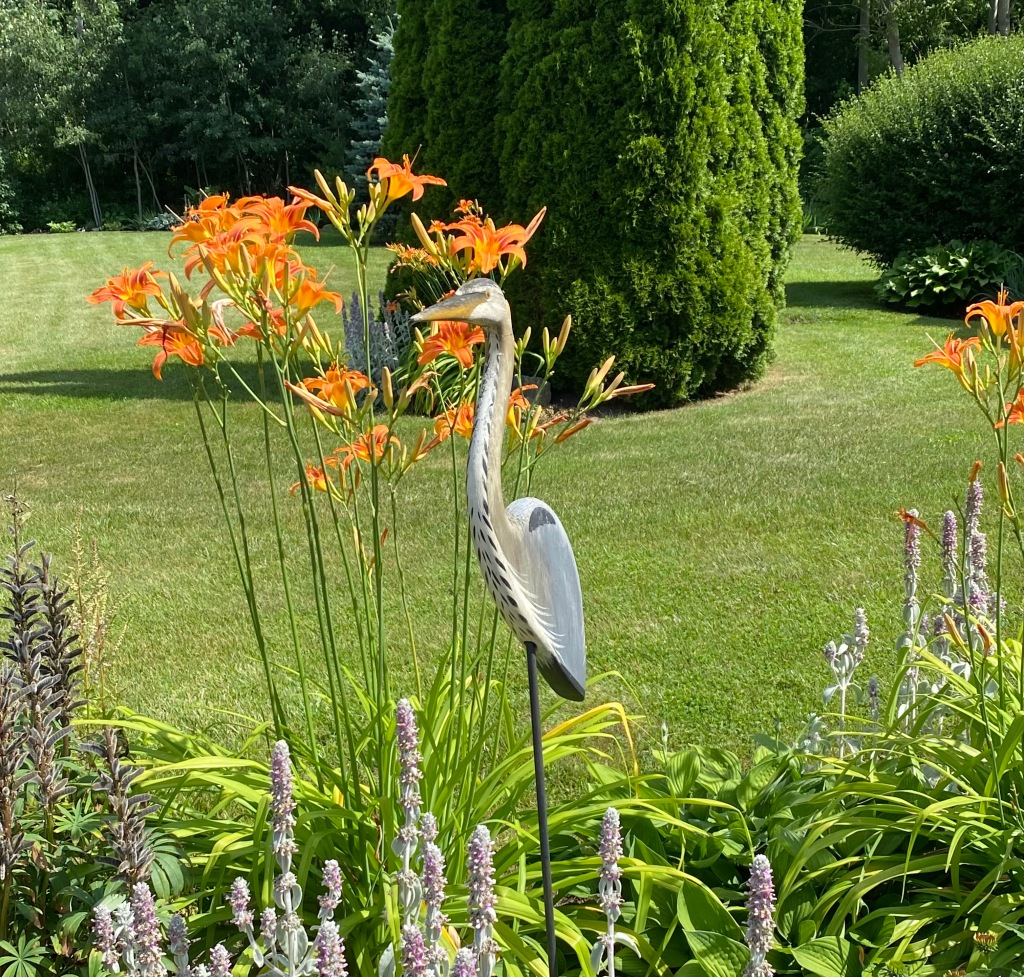

Orange Daylily (Hemerocallis fulva), left, in a garden in near Gananoque, Ontario, and Wood Lily (Lilium philadelphicum), right, in the wild on the west coast of the Bruce Peninsula, Ontario.
Lilies always make a lovely addition to a garden and are especially wonderful when their eye-catching blooms in fiery orange, held aloft on long, wiry stems, are put to dramatic effect as seen in the photo above left. When you have a large flower bed that needs some colour interest at a higher level, lilies are great option. But which lily to choose? (I’m using the term lily loosely here as only plants from the Lilium family are actually lilies). When it comes to the orange kind, you can go with a native or a non-native.
Wood Lily (Lilium philadelphicum), with its bright orange petals freckled with dark spots, is native to most of Canada. It’s a surprisingly versatile plant, growing in conditions from sunny to shady. But it’s not a hugely popular plant and you may have to do a little searching to find where they’re available in your area. Try reputable native plant specialists.
Orange Daylily (Hemerocallis fulva) aka Ditch Lily originally hails from Asia and, as of 2020, was added to Ontario’s Invasive Plant Council list. This is because they run riot if left to their own devices. Proof can be found on any summer’s drive down a country road in southern Ontario where you’ll find banks and ditches choked with them. But they can be kept under control with diligence. Line the planting hole with a barrier to corral the roots and keep a watchful eye on any escapees which can be dug out easily enough if you get them soon enough.
FYI: If you have a moist spot in sun or part shade and want extra height, try the spectacular Michigan Lily (Lilium michiganense). A native of parts of the U.S. as well as Ontario, it can grow upwards of 6 feet with bright orange blooms that point downwards with petals that turn up much like a Turk’s Cap lily.
- Full sun. Wood Lily will tolerate shade.
- Well drained soil. Wood lilies can tolerate dry and rocky soils and, hence, make a great addition to a rock garden.
- Orange daylily has good drought tolerance.
- Both lilies are beloved by hummingbirds.
The fabulous vine that can mask a multitude of evils.
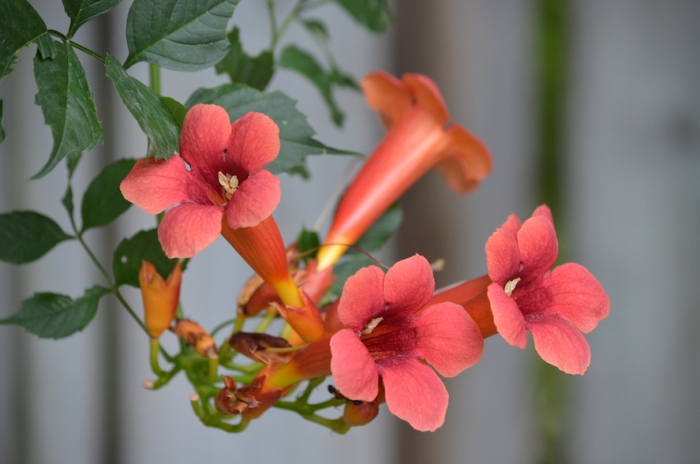
The blush orange blooms of the Trumpet Vine, shot in my old garden in Oakville, ON.
Trumpet Vine or Trumpet Creeper (Campsis radicans) is only native to Canada in Ontario but is wildly apparent in pretty much every state in the eastern half of the U.S. You need to give this plant lots of elbow room as it can grow up to 35 feet in length but, for that very reason, it works really well for creating privacy in a garden, covering a fence or trellis in dense greenery spangled with these gorgeous orange trumpet-like blooms throughout the summer. You can also train this gloriously bushy vine to cover an ugly garden shed or hide a terrible view.
- Full sun
- Not picky when it comes to soil, tolerating most anything from sandy to clay.
- Great drought tolerance
- Attracts hummingbirds and long-tongued bees
- Works well to create privacy in a garden, covering a fence or trellis easily.


 Ministry of the fence
Pingback: The glory of poppies | Ministry of the fence
Because our house is slate blue we use a fair bit of orange and one of my new ones is a lovely Geum. Geum coccineum ‘Borisii’. The UK has a wider selection but this is the closest I could find.
LikeLiked by 1 person
I just looked up your plant. Wow! What a lovely flower. Against slate blue, it would really pop.
LikeLike