Is this the year you’re going to rip up your turf? Are you looking for an alternative ground cover that’s low maintenance, drought resistant and yet still delivers an eye-soothing swath of green where you once had a lawn? (Yes, I realize I’m sounding like a bad TV infomercial. I’ll stop now.) I’m really excited about these three options I discovered last summer. They all deliver loads of lush textural interest, rich green colour all summer long and – Bonus! – they’re all native plants.
Prostrate conifers

A very low growing Creeping Juniper used as a lawn alternative in Southampton, Ontario.
Juniperus horizontalis, commonly called Creeping Juniper, is a native to most of Canada and the northern regions of the U.S. except along the west coast. It’s a low maintenance shrub that, once established, will weather heat and dry spells as well as any nasty North American winter. If you want a lush carpet of green all year round, this is a great choice.
HIGHLIGHTS:
- Grows from 3″ to 6″ in full sun
- Forms a dense, wide mat
- Evergreen for all-year-round colour
- Tolerates a wide range of soils including dry, sandy and poor soils. Just doesn’t like wet soil
- No pruning required
- Doesn’t have a problem with most city air pollutants
- Works well on slopes for erosion control
TRY THESE CULTIVARS:
Juniperus horizontalis ‘Wiltonii’ is commonly called Blue Rug Juniper because its needles have a soft blue tinge to them.
Juniperus horizontalis ‘Pancake’ is a slow grower but gorgeous once it starts to fill in and produces an impressively ground-hugging profile.
Evergreen perennials


Mix of prostrate conifers and Bearberry, also shot in Southampton, Ontario
Arctostaphylos uva-ursi, called Bearberry but often referred to by its adorable nickname, Kinnikinnick, is a native to most of Canada and in the west and northern regions of the United States. Bearberry is, admittedly, a slow grower. However, what it lacks in haste it makes up for in easy going attributes, including drought, heat and cold tolerance. The shiny leather-like leaves put on a surprising show as the seasons change. In spring, its tiny, white-to-pink flowers are lovely and, in fall, you’ll get bright red berries.
HIGHLIGHTS:
- Grows from 6″ to 12″ in sun or part shade
- Spreads to up to 15 feet
- The leaves turn bronze in the fall
- Thrives in the poorest of soils, including sandy and rocky, but won’t tolerate clay.
- No pruning required
- Attracts butterflies and hummingbirds
A WORD OF CAUTION: If you live in bear country, you might want to pass on this plant. It’s earned it’s name well. Bears love Bearberry berries.
AN ALTERNATIVE TO THIS ALTERNATIVE: If you love the idea of a green ground cover that blooms in spring but you’re looking at a woodland or mostly shady area, consider Bunchberry (Cornus canadensis), another North American native. You won’t get year-round greenery but the four-petalled flowers (actually bracts not petals) can show from spring to fall.
Ornamental grasses
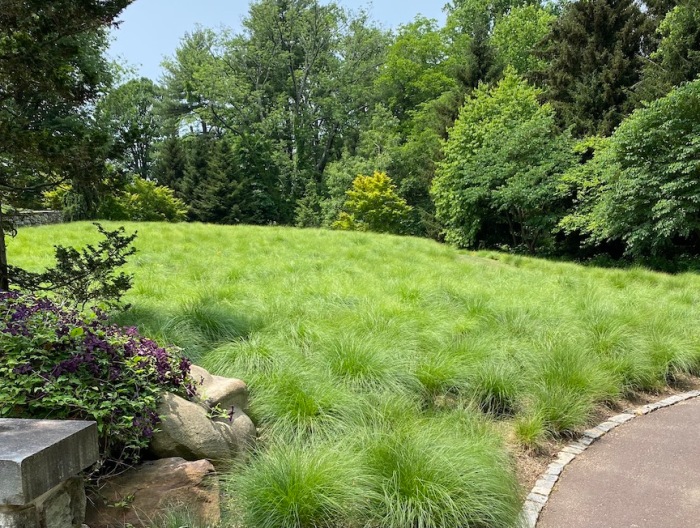
The Sporobolus meadow at Chanticleer
If you want something bigger, bolder, louder, consider an ornamental grass. Granted, you need a lot of room to make this kind of ‘lawn’ work but if you’ve got it, go for it. The Sporobolus Meadow at Chanticleer (shown above) is a great example. Sporobolus heterolepis (Prairie dropseed) grows up to a metre in height and diameter. Its arching foliage mounds of finely textured fronds make for a breathtaking lushness. With even a breath of a breeze, the grasses sway, looking amazingly like a softly rippling bright green sea. It’s a native of central Canada, from Saskatchewan to Quebec, and the U.S. from Colorado down to Texas and as far east as Connecticut.
HIGHLIGHTS:
- Grows up to a metre high
- Each mound can grow to a metre in width
- Year-round interest: Bright green foliage eventually turning golden in fall and bronze in winter. Tiny, pinkish pannicles bloom from August to October.
- Thrives in dry, rocky soils but can tolerate even heavy clay.
- Good drought tolerance
- Doesn’t freely self seed
If I haven’t inspired you to rip up your lawn, that’s fine. There are good reasons to keep a lawn and ways you can make a lawn more eco-friendly.


 Ministry of the fence
Pingback: Tapestry lawns: gorgeous and growing | Ministry of the fence
Just when I’ve rolled out some turf from B&Q in a homage to a lawn. It’s only a tiny thing, just enough for a toddler who is visiting to play on. I’m not a lawn person, but needs must…
LikeLiked by 1 person
I’m sure the toddler will appreciate it!
LikeLike