Winter gardens are simply gardens that have “great bones” as my mother-in-law used to say. These ‘bones’ are the structures that support and delineate a garden throughout the year but can look particularly striking in winter when there’s nothing else (like flowering plants) to distract the eye. They can be man-made, such as a gazebo, a sculpture or an interesting staircase. Or they can be natural, such as a stand of trees, a group of shrubs or a series of hedges.
Hedges in winter can really sing. And when a bunch of stylishly organized hedges sing in harmonic unison, it’s called a parterre.


Two examples of parterre gardens in Toronto, Ontario.
Parterre gardens have a reputation for being a bit lah-di-dah. Read: high maintenance and expensive. But, when you boil the concept down to its essence, it’s no more than an arrangement of symmetrical beds in a decorative pattern. The beds are usually enclosed by low, clipped evergreen hedges that work like tracery framing a stained glass window.
But you don’t necessarily need hedges to get that glorious parterre look.
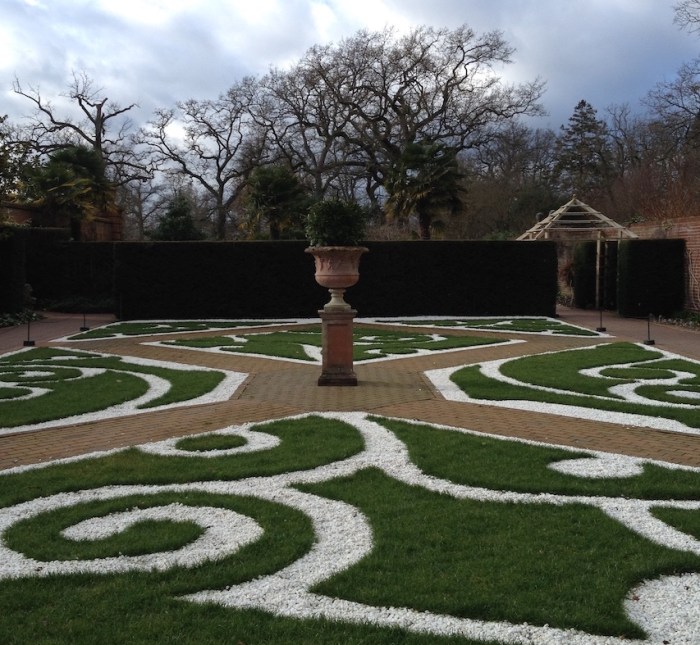
A winter’s parterre using fine turf and white gravel at Wisley Gardens in England.
What I love about the parterre seen above, designed specifically as a winter feature, is that it has a kind of stripped down parterre-ness. It’s a modern combination of the traditional (a symmetry boldly outlined by brick walkways) and the contemporary (each island includes beds with unique designs of swirling shapes).
Shortcuts to a parterre in your garden
If you love the idea of a parterre but don’t love the idea of installing rows of hedges, I hear you. But here’s the thing: You can get that wonderfully elegant and organized look in your garden by side-stepping some of the fuss.
Here are some ideas for getting a relatively pain-free parterre
- DON’T GET HUNG UP ON HEDGES: All those luscious photos of parterres in Cliveden or Versailles are lovely, of course, but they aren’t the be all and end all of parterres. A pathway can work just as effectively as a hedge (as seen above) and makes for easier access to each bed.
- THOSE BEDS CAN BE RAISED: Strictly speaking, the only part of a parterre that’s raised is the hedge surrounding each bed. (See below.) But if you build a bunch of raised beds in a visually pleasing symmetrical pattern, you’ve got yourself a parterre, purists be damned.
- VEGETABLES ARE PARTERRE PARTICIPANTS, TOO: What you fill each bed with is your own business. Vegetables are just as great a choice as roses. If you get really swirly with your parterre design and fill each bed with herbs, well, then you’ve got yourself a Medieval-inspired knot garden which is of the parterre persuasion.
- PLAN YOUR PARTERRE TO FIT THE SPACE YOU’VE GOT: A parterre’s design can be set within a square or a rectangle, a circle or a half moon shape. Really, the only limit is your imagination and the strength of your back. The only rule of thumb is that the beds within the parterre are symmetrical in some way to get that elegant parterre-ness.
No digging? No dirt? No problem.
REPURPOSE SOME PAVEMENT: Got an unused driveway? A deserted patio? An abandoned tennis court? (It happens.) A parterre garden using raised beds over that hardscaping means you’ve got a beautiful new place to sit and/or grow veggies or flowers or whatever with very little weeding to do.
ARRANGE A BUNCH OF CONTAINERS: If raised beds seems like too much work, try containers. Trace out your parterre design with chalk on the paved surface and then fill the ‘beds’ you’ve drawn with containers. Put the largest and tallest of your plants and containers in the centre of each ‘bed’. Make sure you’ve got enough of a pathway between each bed/grouping of pots to walk easily. Voila! Insta-parterre!
DON’T BOTHER PLANTING ANYTHING: If you just love the graphic impact of parterres and you’ve got a patio or deck that needs jazzing up, try painting a parterre-style design like you would paint a fake carpet. Create your own pattern or copy a parterre design from one you’ve seen on Pinterest (I won’t tell) and use cream or light beige paint for your ‘paths’ and a mid-tone green for your ‘beds’. Place a few containers of plants (real or faux) to accent your flat-but-fab porterre and then wait to be the talk of the neighbourhood.
Where did porterre actually come from?
The word parterre comes from the French term for ‘on the ground’. Essentially, the garden’s design was meant to be viewed from a higher vantage point like a balcony or a raised terrace.
SIDENOTE: The word was eventually adopted by the English and used by theatre types in Shakespeare’s day. The parterre was the standing room-only area right in front of the stage. Admission to this part of the theatre was the cheapest and usually attracted a notably rowdy crowd.
So I guess if you were in the parterre, not only were you on the ground but everyone else looked down on you. Don’t let that stop you. Parterre on!


 Ministry of the fence
Pingback: 11 “Oh Wow!” vegetable garden ideas | Ministry of the fence
Could using those keyhole beds be designed into a parterre garden?
LikeLiked by 1 person
Interesting idea! I don’t see why not although purists might not agree. The essence of a parterre is the pattern created by a number of beds laid out in a symmetrical pattern so if you had, say, four keyhole beds positioned in a grid pattern then you would have the elegance of a parterre combined with the easy access and efficiency of a raised keyhole situation. Thanks for your question and inspiration!
LikeLike