There’s a lot of talk about nativars–cultivars of native plants (read: cultivars of plants native to your region.) Ultimately, are these plants a good thing or a bad thing?
Unfortunately, nativars can be more colourful, larger, taller, sturdier, hardier, etc., etc., but at the cost of being sterile, blooming in colours that insects don’t recognize and delivering poor or even no nutrition to them.
One team of researchers reported that cultivated varieties “considerably differed in life-history traits from their wild relatives”, that “wild plant species coped better with local climatic conditions than their cultivated varieties” and the general conclusion was that “the use of cultivated varieties of native plants should be avoided in re-vegetation.” But that was in 2013.
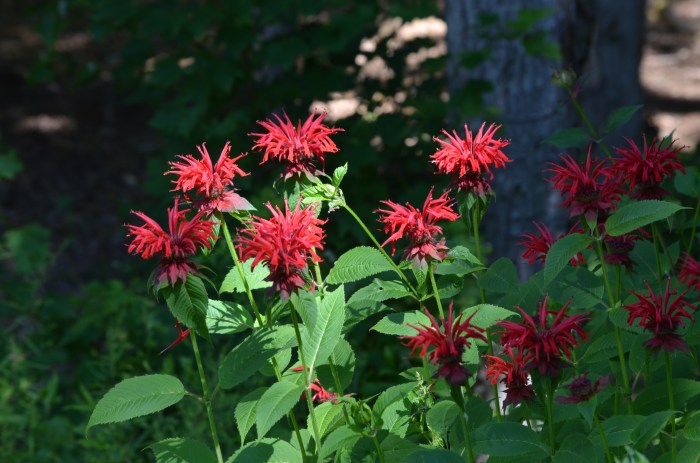
Of the popular Monarda, our native in Ontario is Monarda didyma (Scarlet Beebalm). A cultivar is ‘Raspberry Wine’ Monarda, which looks really similar to its native cousin, but is particularly resistant to powdery mildew.
This is still a growing field of study (pun not intended but kinda funny anyway). We’ve learned that local insects, for instance, can adopt to nativars as sources for food and shelter, over time, if there are no native options available to them.
And, as it turns out, some nativars are actually a really good thing, offering just as much nutrition as a native species but also delivering better hardiness. For instance, the Phlox paniculata cultivar ‘Jeana’ has better resistance to downy mildew than plain old native Phlox paniculata. Cercis canadensis (Eastern Redbud) ‘Columbus strain’ is also considerably hardier than the native.
Nativars don’t just impact how gardeners will choose plants in the future, either. Farmers are looking at nativars, too, hoping they might solve some of the challenges the agriculture industry faces. Check out Can taming wild plants help feed a crowded planet? | St. Louis Public Radio
What’s the bottom line?
As we all know, the minute you start messing around with Mother Nature, you risk all sorts of impactful consequences. A big concern is that eventually nativars will lead to a loss of genetic diversity. That, of course, should be a huge concern.
For gardeners, I believe choosing nativars responsibly has a lot to do with your garden’s location. Hear me out:
If your garden is already about as un-wild as you can get, full of alien/ornamental plants–from the lawn to your beds to your containers–without a native to be seen except for the occasional weed or tree, and you’re surrounded by un-wilderness, i.e. the city or suburban garden, then nativars just might be a good thing for your garden. Yes, native cultivars as less ideal than pure natives. But in urban environments, they can be a better choice than pure non-natives. Often, nativars are easier to grow and adapt better to an urban garden. So with the idea that something to help wildlife is better than nothing, cultivars may be helpful for encouraging biodiversity within urban settings such as city green spaces and suburban gardens.
But, if you want to support your local wild food web, also plant as many native plants as you can! If you can only plant one native thing, plant an oak. Oaks are the ultimate sharers. Their leaves sustain the most amount of caterpillars of any tree species in North America. And caterpillars turn into one of two things: cute winged beasties such as butterflies or lunch for birds. It’s a win-win. Read 5 great reasons why oak trees are the lovingest of all the plants you can grow in my post Plant an Oak: The Tree That’s All Heart.
If you’re curious about what kinds of nativars are available in Ontario, here’s a brief list:
Some examples of Ontario nativars
- ‘Mariachi™ Salsa’, a dwarf Sneezeweed, from native Helenium autumnale (Sneezeweed)
- ‘Espresso’ Spotted Cranesbill, from native Geranium maculatum (Wild Geranium)
- Heuchera ‘Stainless Steel’, from native Heuchera americana (Coral Bells)
- ‘Summerina® Brown’ Echibeckia™, a cross between natives Echinacea purpurea (Purple Coneflower) and Rudbeckia hirta (Black-Eyed Susan)
- ‘Summer Wine®’ Ninebark, from native Physocarpus opulifolius (Ninebark)
- ‘Sombrero Hot Coral’ Coneflower, from native Echinacea purpurea (Purple Coneflower)
What’s your opinion on this? Have you noticed any insects flocking to or avoiding any nativars in your garden?


 Ministry of the fence
Pingback: Coreopsis a star reborn in the summer garden | Ministry of the fence
Great post! I often think of gardens as a food pyramid – ideally the bottom layer should be native fare and the exotics at the top. My own garden is a terrible example of this – it’s where I experiment and learn, so it’s mostly a one-of-each-itis kind of thing. It’s very shady, so not a lot of flowers, but I do have a lot of birds flitting around. Great protective cover, I imagine. I do have a fair share of native plants as well. And I whole-heartedly support what you said about oaks – they are amazing trees. I only wish they grew a little faster…
LikeLiked by 1 person
Thanks so much! I really like your idea of gardens as a food pyramid. My garden is completely shade too. Since I can’t have bright flowers I find myself all excited about the smallest characteristics of my basically all-green plantings! And, yes, oaks are a commitment for sure! Both in time and space.
LikeLiked by 1 person
Very timely post – this is an area of very active research and controversy. University and Botanical Garden studies are ongoing – studies find that some nativars are actually more attractive to pollinators than the native species (although not always). It depends on the species and the cultivar; there is no blanket rule. It also depends on the trait examined: leaf colour is important, as is flower colour and shape. In general, the double forms of Echinacea are less attractive to pollinators than the simple forms, but there are some simple forms which are very attractive to pollinators. In my landscape design practice, I always consider Nature as one of my clients (although a silent one), and encourage my clients to consider the environment as well, and to be stewards of their land, leaving it in better condition than it originally was. Congratulations, and keep up the good work! Martine (M A Jaworski Landscape Designs, Ottawa).
LikeLiked by 1 person
Thank you so much for that wonderful information. And I love your attitude: including Nature as a client. Love it! I so appreciate your comments.
LikeLike