Last Monday was Victoria Day here in Canada, a national holiday that was once the official day to celebrate Queen Victoria’s birthday and is now simply our unofficial kick-off to spring. This weekend also semi-reliably marks the moment when danger of overnight frost has passed–at least for most Canadians. Hence, gardening centres finally fling open their doors. With all the hubbub around this revered weekend–garden maintenance power tools revved, nursery parking lots jammed–I started thinking about how much the actual Victorian era (we’re talking mid- to late 1800’s) influenced how we garden now.
Surprisingly, there’s a lot.
Large lawns
THEN: Lawns were important back in Queen Vic’s time. In fact, it’s been argued that the ”single most important aspect of Victorian landscape [was] the lawn.” On balmy days, these manicured carpets of green were used for the bulk of outdoor socializing–tea parties, croquet games, strolling with loved ones. But they were also introduced as a sweeping statement (in typical Victorian hubris) that the gardener was in full control of his surroundings, taming the wilderness with a blanket of absolute calm.
NOW: We still love our lawns, despite the controversies, although patios and decks are now part of any high use area in a garden. And, interestingly, I think, lawns–front lawns in particular–are still often used as more of a statement than serving any practical purpose.
The big border
THEN: Renowned landscape designer Gertrude Jekyll, who lived during Queen Victoria’s reign, is credited with making the herbaceous border popular.
NOW: Who doesn’t love a huge bed overflowing with plants, blooming or otherwise? All it takes is space and lots of it.
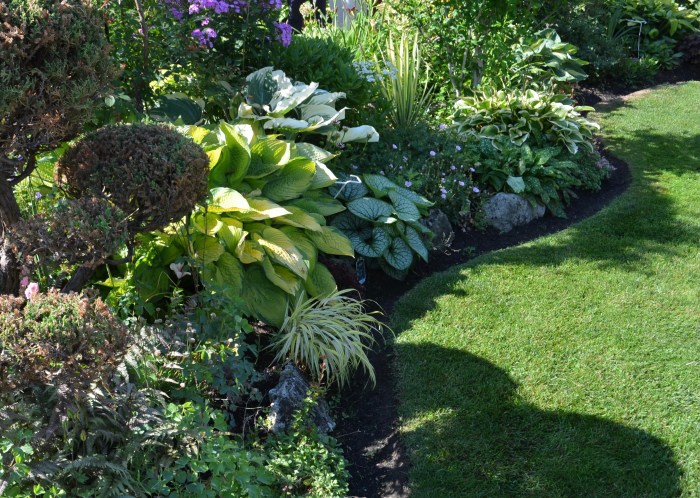
A well maintained lawn, a long, wide border crammed with specimen plants, and the generous use of hostas, were three popular elements in the Victorian garden and they still are today.
Exotic plants
THEN: Plants like hostas may seem like the ho-hum filler everyone puts in their gardens these days but they used to be considered quite the rare and desirable must-have back in the day. Native to Japan, Korea and China, they were imported to England in 1790 and didn’t reach North America until the early 19th century. But soon after they began to become a sought after collector’s item.
NOW: We’re still in love with hostas and our desire for other once-exotic plants hasn’t stopped. When you think of it, any run-of-the-mill garden centre these days will be well stocked with plants that were once natives of far away lands. In fact, trying to find unadulterated native plants (that is, plants that are actually native to your region) is way less easy.

An Elephant’s Ear plant lends an exotic tropical vibe to this planter thriving in non-tropical Ontario.
Fancy fencing
THEN: Fencing was a way to broadcast your wealth and social standing. The more fence and the more elaborate the design of the fencing, the more prestigious the owner–think wrought iron fencing with curly cue gates and beautifully built brick walls.
NOW: I previously wrote in 6 Easy Shortcuts To A Classic Canadian Garden that, if you want that quintessential Canadian garden look, you tried to avoid fencing of any kind. But fences are still unavoidable, particularly if you live in a high density residential area. And vestiges of that Victorian penchant for wrought iron can still be found in modern day gardens albeit abbreviated to the forms of arches which technically still perform the task of delineating a space if only its entrance.

Gone are the wrought iron fences but their ghosts appear in our modern gardens in the form of arches.
Loads of bright colours
THEN: The minimalist, monotone garden was still way, way in the future. In Victorian times, gardens were often an explosion of bright fun flowers contrasting with each other, the better to emphasize the gardener’s access to the latest plant discoveries.
NOW: We haven’t lost our taste for brilliant blooms but nowadays we may take the whole more-is-more aesthetic to greater heights by painting our homes a bright, contrasting colour as well.

A modern day version of the English garden often includes a home with an equally bright paint job.
Rock gardens
THEN: With all the new plants being introduced, Victorian gardeners were inspired to showcase their new finds in ways that complemented the plants and hinted at far away destinations. Alpine plantings in particular were a big, new thing.
NOW: The Alpine-inspired rock garden is still a popular garden feature but, thanks to endless choices of plants bred to weather our own climate, we can mimic almost any kind of environment in our North American back yards. So if you want to transform your suburban Montreal patio with a garden reflecting fond memories of a trip to Mexico, bring on the yuccas and Bougainvillea!
Complementing the house
THEN: Gertrude Jekyll is widely hailed as the British garden designer who first encouraged a connection to be made between a garden and the owner’s home, such as choosing shrubs and trees that complemented the proportions of the house or were placed to not only make an entrance easy to locate but also welcoming.
NOW: Who hasn’t heard about curb appeal? Thanks to a zillion home reno TV shows we can’t help but consider how our gardens will help “sell” our home, even when the customers are ourselves. There’s an entire gardening industry devoted to helping us stoke our visions, whether borne of house pride or savvy landscape design.
Garden ‘rooms’
THEN: Jekyll also championed the idea of adding surprise to the garden–a novel concept at the time if you exclude the ha-ha, a sunken fence that gave the viewer of the garden the illusion of an unbroken, continuous rolling lawn, while providing boundaries for grazing livestock. That idea was introduced to England from France a century earlier. The name comes from the surprise the viewer would get when they were suddenly upon the lip of the deep trench (although I think that feeling of schadenfreude when it wasn’t you who broke their leg upon discovering one may also have factored into it).
Jekyll’s surprises were more about divvying up a garden in order to introduce the unexpected like a garden path that lead to a special view or a private seating area hidden from view by shrubbery.
NOW: With an ongoing quest for getting the most out of what we’ve got, the idea of rooms has softened into simply playing with different areas within a garden, often signalling a special spot with a small cluster of seats. The beauty of this idea, so appealing nowadays, is that you really don’t need a large garden to have one that’s a great multi-tasker and even the smallest of gardens magically feels larger.

Even a garden design with a loose structure can have ‘rooms’ by carefully chosen seating areas.
Getting looser
THEN: You’d think that Victorian gardens would be pretty strait-laced. But in the latter half of the 1800’s, Ms. Jekyll partnered with William Robinson in heralding the idea of moving away from formality and adding a bit of wildness to the garden. Mind you, this more naturalized look was acheived with typically Victorian flourishes, mixing plenty of exotic plants with natives and native cultivars to get the desired “natural” look.
NOW: That oh-my-garden-woke-up-looking-this-way is still probably our most loved trend of all.
What we haven’t brought into the 21st century
- Shaped beds with flowers planted in graphic designs. You know the kind. You still may see one in a public park where a huge bed of impatiens in different colours spells out the city name and roughly approximates an emblem of some sort.
- A need to finely finish every little detail. Unpainted wood, for instance, would not have be done back then. Now, wooden decking finished in a natural stain or some manufactured faux wood is part and parcel of a modern home.
- High maintenance gardens. Don’t get me wrong. If your life’s passion is tending to your garden, then more power to you. But, for those whose lives are pulled in many time-consuming directions, gardening tends to be a part-time activity and that means employing as many time-saving elements as possible.
- Glass greenhouses. Sure, this has a lot to do with money and space but, let’s face it, back in the day, you needed to coddle your rare plant specimens in the best way possible, It’s not like you could hop in the car and go to your nearest garden centre to replace whatever plant suddenly expired. And you also needed to show them off in an appropriately grand way. Perhaps the modern equivalent of the grand Victorian glass greenhouse is our garden shed, which in its own turn, is getting bigger and more luxurious and has a new name such as She Shed or Garden Studio.


 Ministry of the fence